Still relying on traditional chassis fabrication? Rising material waste, weld inconsistencies, and production delays could be costing you more than you realize. Learn how modern laser cutting, welding, and marking technologies are helping tractor manufacturers stay ahead.
The tractor chassis is one of the most critical structural components in agricultural machinery. Often referred to as the backbone of a tractor, the chassis supports the engine, transmission, axles, fuel tank, hydraulic systems, cabin, and multiple heavy-duty attachments. Since tractors operate in demanding agricultural environments, rough terrains, muddy fields, heavy loads, vibrations, and continuous stress, the chassis must be engineered for exceptional strength, dimensional accuracy, and long-term durability.
Modern tractor chassis manufacturing has evolved significantly with the adoption of fiber laser cutting machines, CNC bending systems, robotic welding, and automated finishing processes. These technologies help manufacturers achieve superior precision, reduced material waste, faster production, and better structural consistency.
Modern agricultural equipment manufacturers are increasingly adopting advanced laser solutions to improve production quality and throughput. Whether using a high power laser cutting machine for thick structural steel or a lower power laser cutting machine for precision brackets and mounting components, laser technology helps manufacturers achieve consistent results. Along with cutting applications, laser welding machines and laser engraving machines are becoming essential in modern tractor manufacturing facilities.
Manufacturers looking to improve overall agricultural equipment production can also explore Tractor Manufacturing Using Fiber Laser Cutting Machine: Complete Guide to Modern Precision Production and Thresher Manufacturing: How Laser Cutting is Revolutionizing Thresher Parts Production to understand how laser technologies are transforming the agricultural machinery sector.
This blog explores the complete process of tractor chassis fabrication using laser cutting machines and advanced manufacturing methods.
Importance of Tractor Chassis in Agricultural Machinery
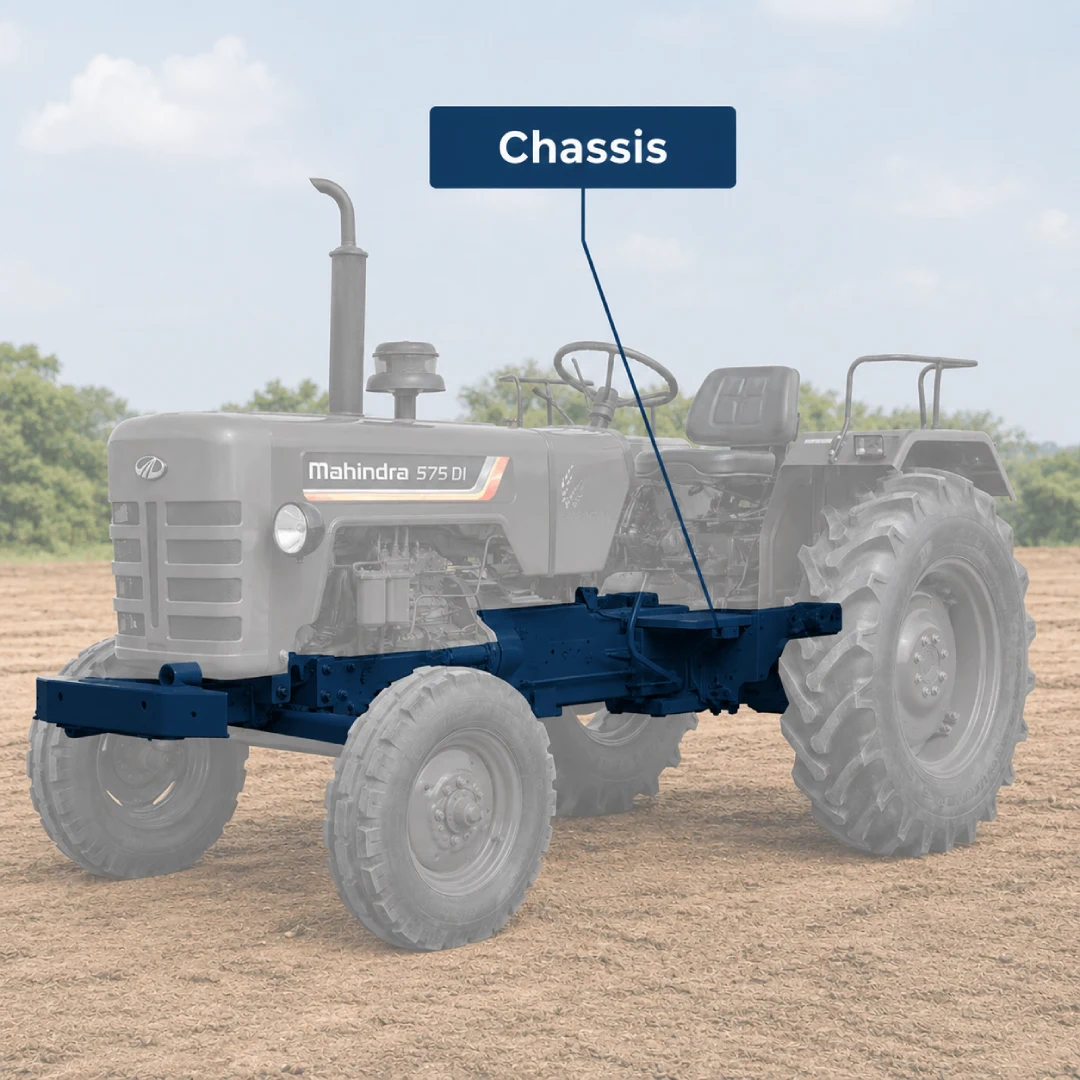
A tractor chassis serves as the primary support framework of the machine. It carries mechanical loads while maintaining stability during operation.
A well-manufactured chassis directly impacts:
- Load-bearing strength
- Structural rigidity
- Vehicle balance and stability
- Operator safety
- Durability in harsh field conditions
- Resistance to vibration and fatigue
- Easy integration of engine and transmission components
Because of these requirements, tractor chassis fabrication demands high-precision engineering and robust manufacturing techniques.
Raw Material Selection for Tractor Chassis Fabrication
The manufacturing process begins with selecting suitable raw materials. Common materials include:
1. High-Strength Mild Steel: Widely used for heavy structural frames due to its strength and weldability.
2. Alloy Steel: Used in high-load applications requiring better wear resistance.
3. Structural Steel Plates: Provide rigidity and support in frame assemblies.
4. Tubular Sections: Used for cross-members and reinforcement structures. Material selection depends on:
- Tractor size
- Load capacity
- Terrain application
- Corrosion resistance requirements
- Design specifications
Material utilization plays a major role in overall production costs. Modern nesting software allows manufacturers to maximize sheet usage before processing parts on a laser cutting machine. Advanced nesting strategies reduce scrap generation and improve profitability, especially when processing large volumes of steel components.
For a deeper understanding of this process, manufacturers can explore Nesting Software and Material Optimization: How Manufacturers Save Up to 20 Percent Cost. The article explains how intelligent nesting works alongside CNC laser cutting machines to reduce waste and improve manufacturing efficiency.
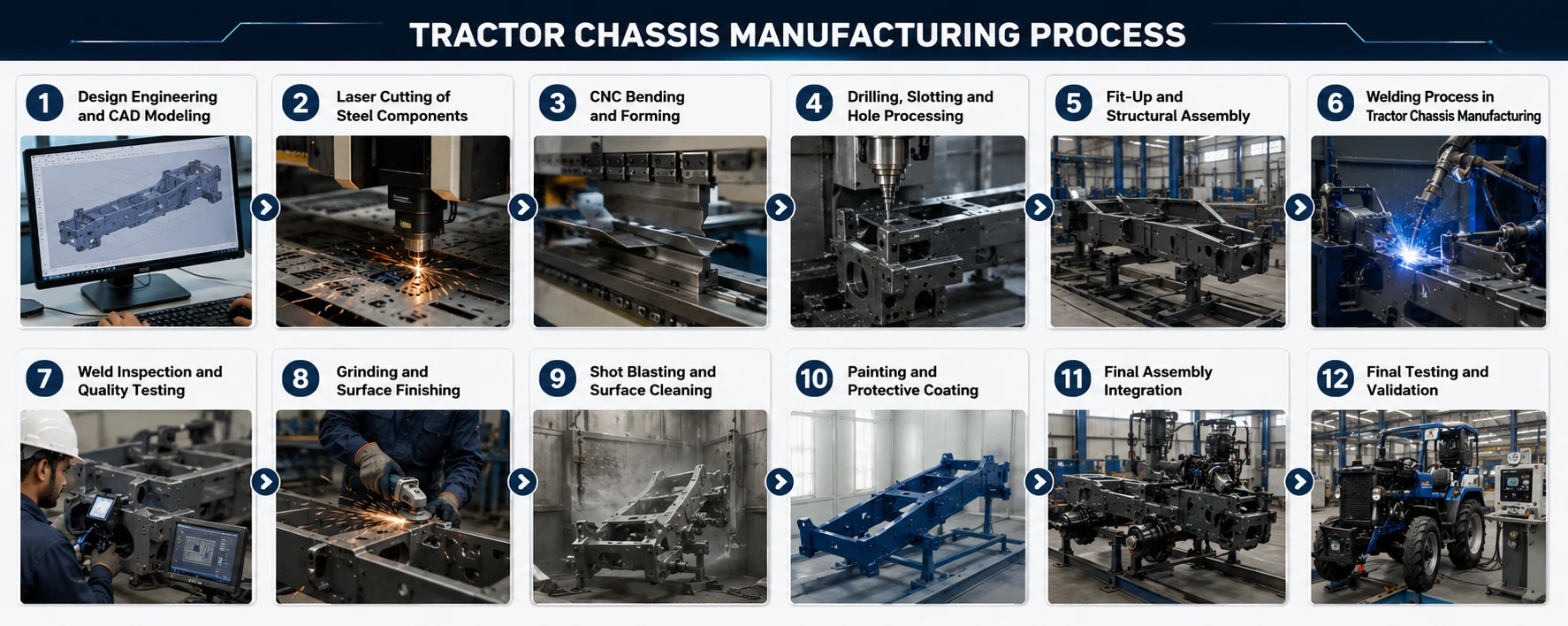
Step 1: Design Engineering and CAD Modeling
Before manufacturing begins, the tractor chassis is designed using CAD (Computer-Aided Design) software.
Engineers create:
- Main frame rails
- Cross-members
- Engine mounting brackets
- Axle support structures
- Suspension mounting points
- Hydraulic support brackets
- Reinforcement sections
Simulation tools help analyze:
- Stress distribution
- Load-bearing capacity
- Impact resistance
- Vibration control
- Structural deformation
This ensures the chassis design is optimized before production.
Step 2: Laser Cutting of Steel Components
One of the most important stages in tractor chassis manufacturing is fiber laser cutting.
Laser cutting machines process heavy steel plates, tubes, and brackets with extremely high precision.
Components Cut Using Laser Machines
- Frame rails
- Support brackets
- Mounting plates
- Engine supports
- Axle plates
- Reinforcement ribs
- Cross-member plates
- Suspension brackets
- Hole patterns for bolts and fixtures
How Fiber Laser Cutting Works
A high-power fiber laser beam is directed onto steel material. The intense heat melts the metal, while assist gas removes molten particles.
Benefits of Laser Cutting in Tractor Chassis Manufacturing
- High Precision
- Burr-Free Edges
- Faster Production
- Minimal Material Waste
- Clean Hole Quality
- Consistent Repeatability
Today’s fiber laser cutting machine technology supports both high-volume production and custom manufacturing requirements. Depending on material thickness and production requirements, manufacturers can choose between lower power laser cutting machines for thinner components and high power laser cutting machines for heavy-duty structural applications.
Many manufacturers also invest in long-bed systems to process oversized chassis sections efficiently. Companies handling large agricultural frames can learn more through What Is a Long Bed Laser Cutting Machine and Why Does Your Industry Need One? which explains how extended work areas improve productivity and reduce repositioning time.
For manufacturers seeking guidance on selecting the right laser solution for agricultural fabrication, SLTL Group offers advanced laser cutting machines designed for both standard and heavy-duty production environments.
Contact SLTL Group at +91 99250 36495 or email mkt@sltl.com. You can also visit at www.sltl.com to know more about our machines.
Step 3: CNC Bending and Forming
After cutting, components move to CNC press brake bending machines.
These machines shape metal sheets and structural sections into required geometries.
Operations include:
- Angular bends
- U-channel formation
- Reinforcement flanges
- Side frame profiles
- Structural edge folding
Advantages include:
- High dimensional accuracy
- Consistent bend angles
- Reduced deformation
- Better assembly alignment
- Stronger structural reinforcement
Proper bending ensures load distribution and mechanical stability.
Step 4: Drilling, Slotting and Hole Processing
Although laser cutting often creates holes, some critical areas require additional machining.
Processes include:
- Drilling
- Slotting
- Reaming
- Thread tapping
- Surface machining
These operations help create:
- Bolt mounting points
- Hydraulic line passages
- Gearbox mounting holes
- Precision fixture interfaces
- Engine assembly points
Accurate hole placement is essential for alignment.
In addition to mechanical processing, many manufacturers now use laser engraving machines to mark part numbers, serial codes, traceability information, production dates, and quality control identifiers directly onto chassis components.
Step 5: Fit-Up and Structural Assembly
Once all components are processed, assembly begins.
- Frame rails are positioned
- Cross-members are aligned
- Brackets are fixed
- Reinforcements are inserted
- Mounting structures are checked
Fixtures and jigs are used to maintain geometry.
Precision fit-up ensures strong final construction.
Step 6: Welding Process in Tractor Chassis Manufacturing
Welding is one of the most critical stages.
Common welding technologies include:
- MIG Welding
- TIG Welding
- Robotic Welding
- Arc Welding
Welding areas include:
- Frame rail joints
- Cross-member welds
- Bracket mounting welds
- Support reinforcements
- Suspension structures
- Load-bearing joints
- Axle supports
Benefits of automated welding include:
- Stronger joint penetration
- Reduced human variation
- Uniform weld beads
- Higher productivity
- Better structural integrity
While traditional welding methods continue to be used in large fabrication facilities, laser welding machines are gaining popularity due to their precision and consistency.
For repair work, prototype development, and flexible fabrication requirements, handheld laser welding machines provide an efficient alternative. These systems allow operators to achieve cleaner welds while reducing post-processing requirements.
Step 7: Weld Inspection and Quality Testing
After welding, the chassis undergoes inspection.
Testing methods include:
- Visual Inspection
- Dimensional Inspection
- Ultrasonic Testing
- Magnetic Particle Inspection
- Load Testing
These tests ensure reliability and performance.
Step 8: Grinding and Surface Finishing
After inspection, weld areas are finished.
Processes include:
- Burr removal
- Weld smoothing
- Edge grinding
- Surface correction
- Sharp edge removal
Benefits include:
- Better appearance
- Safer handling
- Improved coating adhesion
- Reduced corrosion points
After fabrication and welding, manufacturers often use laser engraving machines to apply permanent identification markings that support traceability and inventory management.
Step 9: Shot Blasting and Surface Cleaning
Before coating, chassis frames undergo shot blasting.
Steel shots remove:
- Oxidation
- Rust
- Mill scale
- Dust
- Surface contaminants
This creates a clean textured surface.
Step 10: Painting and Protective Coating
The tractor chassis must survive moisture, fertilizers, mud, and harsh weather.
Protective finishing includes:
- Powder Coating
- Industrial Painting
- Anti-Corrosion Primer
- Epoxy Coating
This extends service life significantly.
Step 11: Final Assembly Integration
Mounted components include:
- Engine
- Gearbox
- Transmission
- Hydraulic system
- Steering system
- Axles
- Fuel tank
- Wheels
- Cabin structures
Precision manufacturing ensures smooth integration.
Step 12: Final Testing and Validation
Tests include:
- Static load testing
- Dynamic vibration testing
- Fatigue testing
- Impact testing
- Dimensional checks
- Road simulation
These tests confirm operational durability.
Additional Applications of Laser Technology Across Industries
The same laser solution used for tractor chassis manufacturing is widely adopted across multiple industries.
- Automotive Parts: Laser cutting machines are extensively used for chassis components, brackets, mounting structures, body panels, and reinforcements.
- Tool and Mold Manufacturing: Precision cutting and marking help manufacturers produce accurate tooling components.
- Jewelry: Laser engraving machines support intricate engraving and personalization.
- Aerospace: High power laser cutting machines process lightweight and high-strength aerospace materials.
- Electronic: Laser systems support precision component fabrication and marking.
- Medical Devices: Manufacturers use laser technology for surgical instruments and traceability marking.
- Construction: Structural steel fabricators depend on laser cutting machines for beams, plates, brackets, and framework components.
Manufacturers working with tubular structures may also benefit from reading Tube Laser Cutting for Agricultural Machinery and Light Structures.
Advantages of Laser Cutting Machines in Tractor Chassis Manufacturing
Fiber laser cutting has transformed agricultural equipment fabrication.
- Superior Precision
- Faster Throughput
- Lower Scrap Rate
- Reduced Manual Labor
- Better Structural Accuracy
- High Repeatability
- Reduced Secondary Operations
As agricultural machinery continues to evolve, manufacturers increasingly depend on integrated laser solutions that combine cutting, welding, and marking capabilities.
Why Precision Fabrication Matters for Tractor Chassis
A poor-quality chassis can lead to:
- Structural cracks
- Premature failure
- Poor stability
- Increased maintenance
- Operator safety risks
- Reduced machine lifespan
Precision laser cutting and automated fabrication solve these challenges.
Conclusion
Tractor chassis manufacturing is a complex engineering process that demands strength, precision, and durability. From CAD design and high-power fiber laser cutting to CNC bending, welding, blasting, coating, and final inspection, every step contributes to building a chassis capable of handling heavy agricultural operations.
Modern laser cutting machines, laser welding machines, handheld laser welding machines, laser engraving machines, and advanced automation technologies have significantly improved fabrication quality, production speed, and structural reliability.
Looking to modernize your tractor manufacturing process with advanced laser solutions?
Contact SLTL Group at +91 99250 36495 or email mkt@sltl.com. You can also visit at www.sltl.com to know more about our machines.
Our team can help you select the right laser cutting machine, laser welding machine, handheld laser welding machine, or laser engraving machine for your production requirements.
FAQs
1. How do I choose the right laser cutting machine for tractor chassis manufacturing?
You should evaluate your material thickness, production volume, and component sizes first. If you process heavy structural steel regularly, a high power laser cutting machine will give you better productivity and cutting performance.
2. Can a fiber laser cutting machine handle thick steel plates used in tractor chassis production?
Yes, you can process thick structural steel plates with a suitable fiber laser cutting machine. The right machine configuration helps you achieve precise cuts, clean edges, and faster production.
3. My current fabrication process creates too much material waste. Can laser cutting help?
Yes, you can significantly reduce material waste by combining a laser cutting machine with advanced nesting software. Better sheet utilization helps you lower production costs and improve profitability.
4. Should I invest in a laser welding machine for tractor chassis fabrication?
If you want stronger weld quality, better consistency, and faster production, you should consider a laser welding machine. It helps you reduce distortion while improving overall weld appearance and strength.
5. Can a handheld laser welding machine replace traditional welding methods in my factory?
You can use a handheld laser welding machine for many fabrication applications, repair work, and custom jobs. It often provides cleaner welds and requires less post-processing than conventional welding methods.
6. How can I improve traceability and part identification in tractor manufacturing?
You can use a laser engraving machine to permanently mark serial numbers, QR codes, batch numbers, and production details on components. This helps you improve quality control and product tracking.
7. Will a laser cutting machine improve assembly accuracy for tractor chassis components?
Yes, you can achieve better dimensional accuracy and tighter tolerances with laser cutting. This makes component fit-up easier and reduces assembly errors during production.
8. How do I know if a long bed laser cutting machine is suitable for my business?
If you regularly manufacture oversized chassis sections, long structural parts, or large agricultural equipment components, you can benefit from a long bed laser cutting machine because it reduces material handling and repositioning time.
9. What should I look for when selecting a laser solution provider for tractor manufacturing?
You should choose a supplier that offers machine installation, training, after-sales support, automation options, and application expertise. A reliable partner helps you maximize your return on investment.
10. How can I get expert guidance on selecting the best laser cutting and welding solution for my factory?
You can consult with SLTL’s laser experts at +91 9925036945 to evaluate your production requirements and recommend the right laser cutting machine, laser welding machine, handheld laser welding machine, or laser engraving machine for your application.
Author Bio

Mayank Patel
R&D HeadMayank Patel is the Head of Research & Development at SLTL Group, bringing over 20+ years of hands-on experience in the field of laser technology. A forward-thinking innovator, he has played a pivotal role in developing advanced laser cutting, welding, and marking solutions tailored for diverse industries. Under his leadership, SLTL’s R&D division continues to push the boundaries of what laser systems can achieve in modern manufacturing.