Manufacturers using traditional fabrication are already losing productivity, precision, and machine life. See how laser cutting, welding, and marking technology are helping modern thresher manufacturers build stronger, balanced, and longer-lasting rotor drums faster.
The Rotor Drum is one of the most important rotating components in a thresher machine. It plays a direct role in separating grains from stalks, husks, and crop residue through continuous impact, rubbing, and rotational motion. Whether in wheat threshers, paddy threshers, or multi-crop harvesting systems, the rotor drum determines the overall efficiency, durability, and performance of the machine.
Because this component operates at high RPM under constant vibration, heavy load, and abrasive agricultural conditions, its manufacturing requires exceptional dimensional accuracy, strong structural integrity, proper balancing, and long-term wear resistance. Traditional fabrication methods often create alignment issues, inconsistent welding, rough edges, and dimensional errors that can reduce machine life.
Modern laser cutting, laser marking, and laser welding technologies have transformed rotor drum manufacturing by delivering high precision, stronger joints, faster production, and improved consistency. Today, manufacturers are increasingly investing in advanced laser solution systems to improve agricultural equipment production while reducing operational cost and fabrication challenges.
Modern fabrication plants also use advanced Laser cutting machine systems and CNC Laser Cutting Machine solutions to manufacture high-performance agricultural components with repeatable precision. Depending on production requirements, manufacturers can choose a High power laser cutting machine for thick structural components or a Lower power laser cutting machine for precision sheet applications and thinner agricultural parts.
Understanding the Role of Rotor Drum in a Thresher
The rotor drum is a cylindrical rotating assembly that helps separate grains from harvested crops. As crop material enters the threshing chamber, the rotor drum rotates rapidly and creates repeated impact and friction against concave surfaces. This process breaks grain away from stalks and directs material toward separation and cleaning systems.
The rotor drum must perform under harsh operational conditions such as:
- High rotational speed
- Continuous vibration
- Impact from crop loads
- Dust-heavy environment
- Long operating hours
- Abrasive wear from grain and straw
Because of these conditions, even a minor imbalance or fabrication defect can lead to excessive vibration, bearing damage, poor threshing efficiency, and premature equipment failure.
Manufacturers using advanced Fiber laser cutting machine technology can maintain tighter tolerances and achieve smoother drum assembly with better rotational balance. Many agricultural equipment manufacturers are also adopting the Best Laser Cutting Machine for Sheet Metal applications to improve fabrication speed and component consistency.
For manufacturers exploring advanced agricultural fabrication methods, Tube Laser Cutting for Agricultural Machinery and Light Structures explains how tube processing technology improves machine strength, frame accuracy, and productivity.
Key Components of a Rotor Drum
A rotor drum is made of multiple fabricated and machined parts, including:
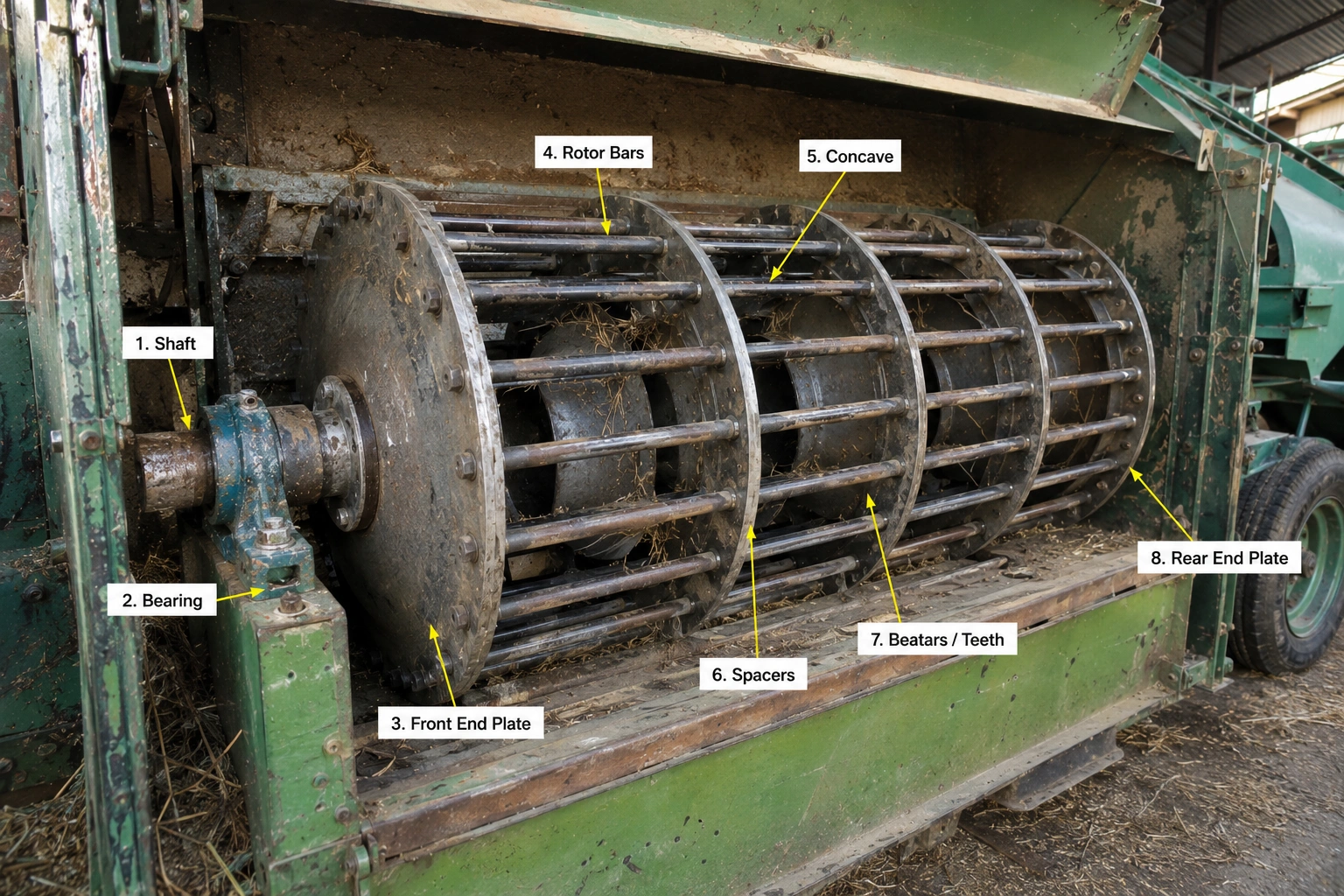
- Cylindrical drum shell
- Perforated sheet sections
- Reinforcement rings
- Shaft supports
- Blade mounting plates
- Beater bars
- Internal ribs
- End plates
- Flanges and support brackets
Each part must be manufactured with tight tolerances to ensure proper assembly and rotational stability.
In modern production environments, Metal laser cutting systems help manufacturers maintain consistent geometry across every component. Advanced Cutting machine for metal applications also reduce manual fitting and improve final assembly accuracy.
1. Laser Cutting in Rotor Drum Manufacturing
Laser cutting plays a major role in producing highly accurate parts for rotor drum fabrication.
Precision Sheet Cutting for Drum Shells
Rotor drum shells are typically manufactured using mild steel, high-strength steel, or wear-resistant metal sheets. Laser cutting machines precisely cut these sheets before rolling them into cylindrical shapes.
Benefits include:
- Smooth, burr-free edges
- High dimensional accuracy
- Reduced material distortion
- Minimal secondary finishing
- Faster production speed
This ensures the shell maintains consistent diameter and proper alignment during final assembly.
Manufacturers often prefer CNC cutting machine solutions because they improve repeatability while minimizing operator dependency. Modern Laser cutter systems also support automated loading and unloading for higher production throughput.
Cutting Perforated and Complex Sections
Rotor drums often include perforated panels, curved cut-outs, and mounting holes for beaters and support structures.
Laser cutting provides:
- Accurate hole positioning
- Uniform slot cutting
- Clean perforation patterns
- High repeatability
- Better fitment during assembly
This improves balancing and structural symmetry.
For manufacturers handling long agricultural sheets and oversized fabrication jobs, What Is a Long Bed Laser Cutting Machine and Why Does Your Industry Need One? explains how long-bed systems improve large-part manufacturing efficiency.
Manufacturing Reinforcement Rings and Plates
Support rings and reinforcement plates maintain drum rigidity.
Laser cutting ensures:
- Identical circular profiles
- Tight tolerance fitting
- Better concentricity
- Reduced manual correction
This directly supports high-speed rotational performance.
Improved Material Utilization
Using nesting software, manufacturers can optimize steel sheet layouts.
Advantages:
- Reduced scrap generation
- Better raw material usage
- Lower per-part cost
- Higher production efficiency
For large-scale thresher manufacturing, this significantly reduces operational expenses.
Manufacturers looking to reduce sheet wastage and improve production profitability can also read Nesting Software and Material Optimization: How Manufacturers Save Up to 20 Percent Cost.
At the same time, advanced nesting software integrated with a Laser cutting machine helps manufacturers maximize sheet utilization while reducing material waste across high-volume agricultural production.
Many agricultural manufacturers also use solutions originally developed for industries such as Automotive parts, Tool and Mold Manufacturing, Construction, Aerospace, Electronic, Medical devices, and Jewelery fabrication because precision manufacturing standards continue to evolve across sectors.
For businesses planning to modernize agricultural equipment production, SLTL Group offers advanced Fiber laser cutting machine solutions designed for high-speed industrial manufacturing. To discuss your production requirements, contact +91 9925036495 or email at mkt@sltl.com.
2. Laser Welding in Rotor Drum Fabrication
After individual components are cut and formed, welding becomes critical in creating a strong and balanced drum structure.
Rotor drums face constant mechanical stress, so weld quality directly affects durability.
Welding Drum Shell Assemblies
Rolled shell sections are joined to create cylindrical bodies. Laser welding offers:
- Deep penetration welds
- Uniform seam quality
- Minimal heat distortion
- High structural integrity
- Faster welding cycles
Compared to traditional arc welding, laser welding reduces warping and keeps the drum dimensionally stable.
Modern manufacturers are increasingly replacing conventional welding with advanced Laser welding machine systems because they provide cleaner welds and better dimensional control.
Welding Reinforcement Rings
Reinforcement rings are attached to strengthen drum walls. Laser welding helps achieve:
- Precise ring alignment
- Cleaner weld seams
- Lower thermal expansion
- Better load distribution
This improves resistance to deformation during high-speed rotation.
Joining Beater Bars and Blade Mounts
Beater bars generate impact during threshing. They must remain firmly attached. Laser welding creates:
- High-strength weld joints
- Uniform penetration depth
- Reduced weak spots
- Better fatigue resistance
This prevents cracking under repeated crop impact.
In repair and maintenance environments, manufacturers also use Handheld Laser welding machine systems for quick repair work, reinforcement, and maintenance welding with lower heat input.
Welding Shaft Supports and End Plates
End plates and shaft supports maintain drum balance. Laser welding provides:
- Precise positional welding
- Reduced misalignment
- Consistent joint strength
- Better rotational stability
A well-balanced rotor reduces vibration and protects bearings.
Reduced Post-Weld Finishing
Traditional welding often creates:
- Spatter
- Excess slag
- Surface irregularities
- Distortion
Laser welding minimizes these issues, reducing grinding and rework time.
3. Laser Marking in Rotor Drum Manufacturing
Although often overlooked, laser marking is highly valuable in manufacturing and maintenance.
Part Identification
Each rotor drum may contain multiple fabricated components. Laser marking can add:
- Part numbers
- Batch codes
- Serial numbers
- Assembly IDs
- Production references
This simplifies identification.
Manufacturers commonly use a Laser engraving machine for permanent industrial marking because it ensures high readability even in dusty and abrasive agricultural environments.
Quality Traceability
If a defect occurs, manufacturers can trace:
- Material batch
- Production line
- Welding sequence
- Inspection history
- Operator records
This improves quality control.
Maintenance and Service Support
Rotor drums undergo wear over time.
Laser marking helps service teams identify:
- Replacement compatibility
- Component size
- Model reference
- Repair history
Permanent marking improves field maintenance.
Non-Contact Accuracy
Laser marking is ideal because it offers:
- Permanent visibility
- No material damage
- Corrosion resistance
- High readability
- Precision marking on curved surfaces
This is especially useful for cylindrical drum components.
4. Importance of Balancing in Rotor Drum Production
A rotor drum rotates at high RPM. Poor balancing creates major problems. Unbalanced drums can cause:
- Excessive vibration
- Bearing wear
- Shaft stress
- Reduced threshing efficiency
- Structural cracking
- Noise increase
- Lower machine life
Laser manufacturing improves balancing because of:
- Consistent geometry
- Accurate hole placement
- Symmetrical fabrication
- Reduced welding distortion
- Precision assembly alignment
This produces smoother operation.
For manufacturers trying to improve agricultural equipment quality and production speed, Thresher Manufacturing: How Laser Cutting is Revolutionizing Thresher Parts Production explains how modern laser fabrication improves overall machine performance.
5. Quality Checks After Manufacturing
Once fabrication is complete, rotor drums undergo inspection.
- Dimensional Inspection: Checks diameter, circularity, and tolerances.
- Weld Strength Testing: Verifies structural durability.
- Dynamic Balancing: Ensures stable high-RPM rotation.
- Surface Quality Check: Confirms burr-free finishing.
- Marking Verification: Checks readability and traceability.
- Assembly Fit Testing: Confirms proper shaft and bracket alignment.
Manufacturers using advanced Laser solution systems can automate many of these inspection processes to improve consistency and reduce production delays.
6. Benefits of Laser Technology in Rotor Drum Manufacturing
Using laser cutting, marking, and welding provides major advantages:
- Faster Production: Reduced fabrication time and higher throughput.
- Higher Precision: Better dimensional consistency.
- Stronger Weld Quality: Improved fatigue resistance.
- Reduced Rework: Minimal distortion and finishing.
- Better Balancing: Stable rotation under heavy loads.
- Lower Material Waste: Optimized sheet usage.
- Improved Durability: Longer component life.
- Traceability: Better quality management.
- Cost Savings: Lower per-part manufacturing cost.
Modern manufacturers prefer advanced CNC Laser Cutting Machine technology because it improves agricultural equipment quality while supporting automation and mass production. The use of the Best laser cutting machine technology also helps reduce downtime and improve long-term operational efficiency.
Conclusion
The Rotor Drum is the heart of the threshing process, directly affecting grain separation efficiency, machine reliability, and overall agricultural productivity. Since it operates under high-speed rotational stress, vibration, and continuous impact, manufacturing this component demands extreme precision and durability.
By integrating laser cutting for accurate component fabrication, laser welding for stronger structural joints, and laser marking for traceability and maintenance, manufacturers can produce rotor drums that are balanced, durable, efficient, and built for long-term field performance.
For modern thresher manufacturing, laser technology is no longer just an upgrade, it is a critical solution for building high-quality rotor drums that deliver strength, accuracy, and consistent agricultural performance.
SLTL Group provides advanced Laser cutting machine, Laser welding machine, Handheld Laser welding machine, and Laser engraving machine solutions for modern agricultural and industrial manufacturing applications. Whether you require a High power laser cutting machine for heavy-duty fabrication or a Lower power laser cutting machine for precision sheet processing, SLTL offers technology designed for productivity, accuracy, and long-term performance.
To discuss your manufacturing requirements or explore advanced laser solutions for thresher production, contact SLTL Group at +91 9925036495, email mkt@sltl.com, or visit www.sltl.com.
FAQs
1. My thresher rotor drum keeps creating vibration during operation. Can laser manufacturing really solve this problem?
Yes, you can significantly reduce vibration issues with laser-based manufacturing. Accurate laser cutting and precision laser welding help maintain proper balancing, alignment, and symmetry in the rotor drum, which improves smooth rotation and protects bearings and shafts.
2. I am facing repeated cracking near the welded areas of my rotor drum. What should I do?
You should consider switching to laser welding technology. Traditional welding often creates uneven heat distribution and weak joints. Laser welding gives you deeper penetration, cleaner welds, and better fatigue resistance, which helps prevent cracking during continuous agricultural operations.
3. I want to reduce material wastage while manufacturing rotor drums. Can a laser cutting machine help me?
Yes, you can reduce raw material wastage with advanced nesting software integrated into a laser cutting machine. It helps you optimize sheet layouts, reduce scrap generation, and improve overall material utilization during production.
4. My current fabrication process takes too much time and labor. How can I improve production speed?
You can improve production speed by using a Fiber laser cutting machine and Laser welding machine. These systems reduce manual handling, minimize finishing work, and increase cutting and welding speed while maintaining consistent quality.
5. I manufacture threshers in bulk. How can I maintain the same quality in every rotor drum?
You can achieve better production consistency with CNC Laser Cutting Machine technology. It delivers repeatable accuracy for every cut, hole, slot, and welded section, helping you maintain the same dimensional quality across large production batches.
6. I struggle with poor fitment during rotor drum assembly. Will laser cutting improve this?
Yes, laser cutting helps you achieve highly accurate dimensions and hole positioning. This improves fitment between drum shells, reinforcement rings, mounting plates, and shaft supports, reducing assembly errors and rework.
7. I want stronger weld joints without heavy grinding and finishing work. Is laser welding worth the investment?
Yes, laser welding is a practical solution if you want cleaner welds and lower post-processing time. You get minimal spatter, lower distortion, and smoother weld seams, which reduces grinding, finishing, and labor costs.
8. My rotor drums wear out quickly in harsh agricultural conditions. How can I improve durability?
You can improve rotor drum life by using precision laser fabrication methods. Better balancing, stronger weld quality, and accurate component manufacturing help reduce stress concentration and improve long-term durability under heavy crop loads.
9. I need proper traceability for parts and maintenance records. Can laser marking help me manage this better?
Yes, laser marking helps you permanently mark serial numbers, batch details, model references, and production IDs on components. This makes maintenance tracking, replacement identification, and quality traceability much easier for your team.
10. I am planning to upgrade my thresher manufacturing setup. Which laser solutions should I consider first?
You should start with a Laser cutting machine for precision component manufacturing and a Laser welding machine for stronger assembly quality. If you also need repair flexibility and maintenance support, a Handheld Laser welding machine can further improve your fabrication operations.
Author Bio

Mayank Patel
R&D HeadMayank Patel is the Head of Research & Development at SLTL Group, bringing over 20+ years of hands-on experience in the field of laser technology. A forward-thinking innovator, he has played a pivotal role in developing advanced laser cutting, welding, and marking solutions tailored for diverse industries. Under his leadership, SLTL’s R&D division continues to push the boundaries of what laser systems can achieve in modern manufacturing.