Poorly manufactured blower fans can reduce grain quality, increase vibration, and shorten machine life. Learn how laser cutting, welding, and marking help manufacturers build durable, high-performance thresher components while staying ahead of the competition.
The blower fan is one of the most critical cleaning components in a thresher machine. After the threshing process separates grains from stalks, husk, and crop residue, the blower fan creates controlled airflow inside the cleaning chamber to remove lightweight impurities such as dust, chaff, dry leaves, straw particles, and husk, while allowing heavier grains to settle properly. This air-based separation significantly improves grain purity, reduces manual cleaning effort, and enhances the overall efficiency of agricultural processing.
Because blower fans operate at high rotational speeds under continuous airflow pressure, vibration, dust-heavy environments, and prolonged working hours, their manufacturing requires precise balancing, strong structural assembly, accurate blade geometry, and durable weld quality. Even small dimensional errors can reduce airflow efficiency, increase vibration, generate excess noise, and shorten machine life.
Modern laser cutting, laser marking, and laser welding machines have transformed blower fan manufacturing by delivering precise fabrication, strong joints, reduced material waste, and high repeatability. These technologies help manufacturers build durable blower fans capable of stable operation in demanding agricultural conditions.
Understanding the Role of Blower Fan in a Thresher
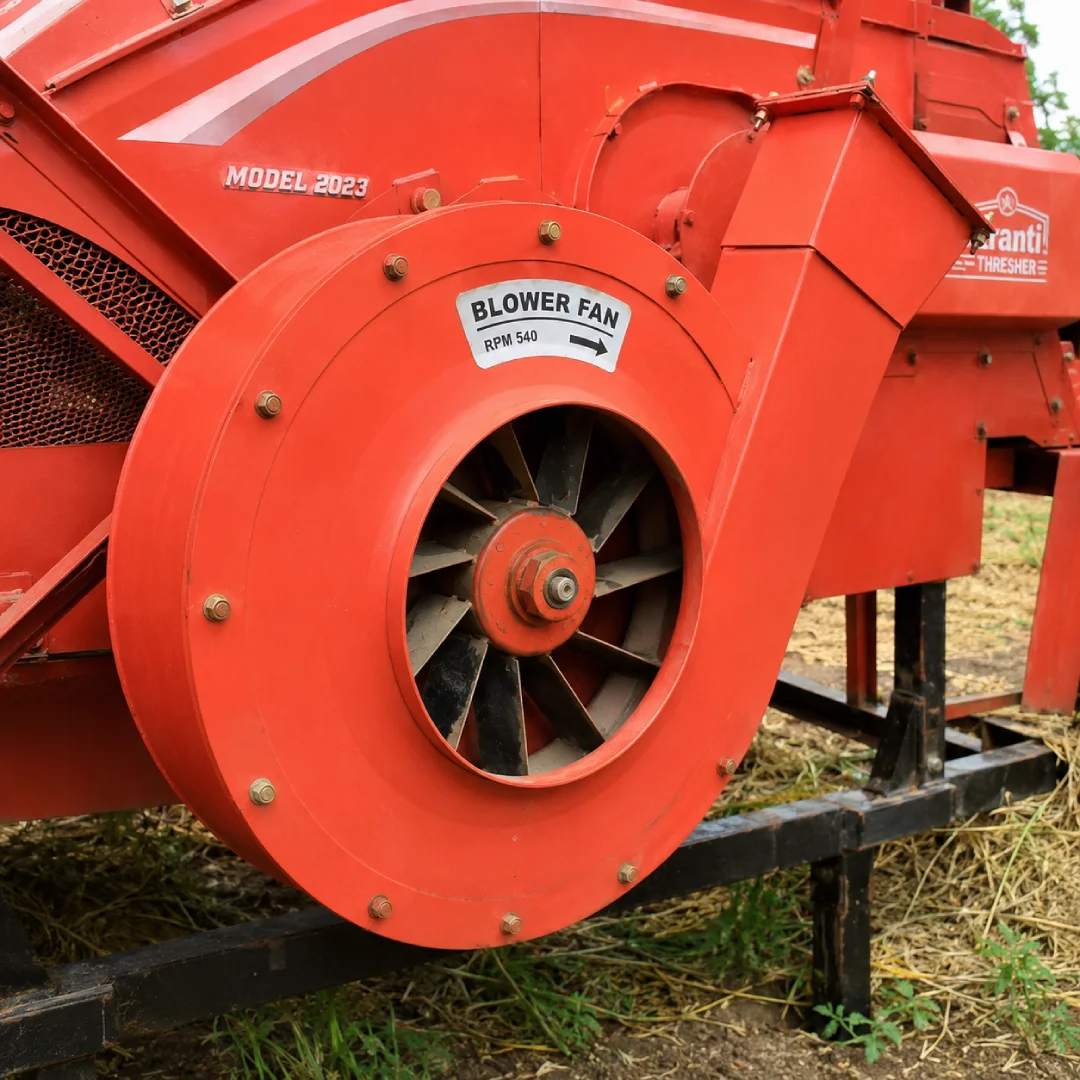
The blower fan is installed inside the cleaning or separation chamber of a thresher machine. Once grains are detached, mixed crop material enters the cleaning zone. The blower fan pushes air through this section to separate heavy grains from lightweight impurities.
Its primary functions include:
- Removing dust and fine debris
- Separating husk and chaff
- Improving grain cleanliness
- Supporting efficient crop flow
- Reducing post-threshing cleaning work
- Maintaining high productivity
A properly designed blower fan improves grain quality while minimizing loss of usable crop.
Major Components of a Blower Fan Assembly
A thresher blower fan includes multiple fabricated and machined parts:
- Fan blades
- Hub plate
- Rotor disc
- Blade supports
- Shaft mount
- Reinforcement rings
- Side plates
- Fan housing
- Air guiding vanes
- Mounting brackets
- Protective covers
Each part must maintain tight tolerances for proper airflow and rotational stability.
1. Laser Cutting in Blower Fan Manufacturing
Laser cutting is one of the most valuable technologies in manufacturing blower fan components.
Precision Cutting of Fan Blades
Fan blades determine airflow direction, pressure, and cleaning efficiency.
Laser cutting ensures:
- Uniform blade profiles
- Sharp dimensional consistency
- Smooth edge quality
- Accurate aerodynamic geometry
- Reduced burr formation
Precise blade shaping helps generate balanced and consistent airflow.
Manufacturing Hub Plates and Rotor Discs
The hub plate connects blades to the rotating shaft.
Laser cutting provides:
- Accurate circular cutting
- Tight center-hole tolerances
- Precise mounting slots
- Better rotational alignment
This supports smooth high-speed rotation.
Cutting Fan Housing Panels
Blower housings guide airflow efficiently.
Laser cutting enables:
- Precise curved profiles
- Slot and vent cutting
- Accurate bend-ready edges
- Consistent panel matching
This improves air channeling.
Reinforcement Ring Fabrication
Reinforcement rings prevent deformation.
Laser cutting creates:
- Symmetrical ring profiles
- Uniform thickness control
- Better concentricity
This improves fan stability.
Reduced Material Waste
With nesting software, manufacturers can optimize steel sheet use.
Benefits include:
- Lower scrap
- Reduced production cost
- Higher material utilization
- Faster batch manufacturing
For large-scale thresher production, this increases profitability.
How Material Optimization Improves Blower Fan Manufacturing
In large-scale agricultural machinery production, manufacturers are constantly looking for ways to reduce raw material costs without compromising quality. Since blower fan components such as fan blades, reinforcement rings, hub plates, side plates, and housings are produced from sheet metal, efficient material utilization becomes extremely important.
Modern laser cutting machine systems are often integrated with advanced nesting software that arranges multiple components on a sheet for maximum utilization. This helps manufacturers reduce scrap, improve production efficiency, and lower overall manufacturing costs.
To understand how advanced nesting strategies help manufacturers achieve significant savings, manufacturers can also read Nesting Software and Material Optimization: How Manufacturers Save Up to 20 Percent Cost.
When combined with a high power laser cutting machine, optimized nesting allows agricultural equipment manufacturers to process large production volumes while maintaining excellent dimensional accuracy and profitability.
2. Laser Welding in Blower Fan Fabrication
Once components are cut, welding is critical for structural strength and balance.
Blower fans operate at high RPM, so weld quality must be consistent.
Welding Fan Blades to Hub Plates
Blade-to-hub connection is one of the most important joints.
Laser welding offers:
- Deep and narrow weld penetration
- Uniform joint strength
- Minimal distortion
- High fatigue resistance
- Cleaner weld seams
This ensures blades remain secure during high-speed operation.
Welding Reinforcement Supports
Blade supports handle rotational stress.
Laser welding provides:
- Accurate placement
- High-strength bonding
- Lower thermal stress
- Better structural rigidity
This reduces cracking.
Housing and Cover Assembly Welding
Fan housings often require joining multiple panels.
Laser welding helps achieve:
- Tight seams
- Clean surface finish
- Minimal spatter
- Faster fabrication
This improves airflow sealing.
Shaft Mount Welding
Shaft mounts must remain aligned.
Laser welding ensures:
- Better positional accuracy
- Stronger concentricity
- Reduced vibration risk
This supports stable rotation.
Less Heat Distortion
Compared with traditional welding, laser welding causes:
- Smaller heat-affected zones
- Reduced warping
- Lower residual stress
This is important for dynamically balanced fans.
3. Laser Marking in Blower Fan Manufacturing
Laser marking improves identification, traceability, and maintenance.
Part Identification
Each blower fan can contain multiple fabricated parts.
Laser marking can permanently add:
- Part numbers
- Batch codes
- Fan size references
- Assembly IDs
- Product serial numbers
This simplifies tracking.
Production Traceability
Manufacturers can track:
- Raw material batch
- Production shift
- Operator data
- Welding records
- Inspection logs
This supports quality control.
Maintenance and Replacement
During servicing, marked parts help technicians identify:
- Compatible replacements
- Fan diameter
- Blade configuration
- Model reference
This reduces downtime.
Permanent and Non-Contact Marking
Laser marking offers:
- Corrosion-resistant identification
- High readability
- No tool wear
- No physical deformation
- Suitable for curved metal surfaces
Ideal for rotating parts.
Laser Marking for Identification and Branding
Apart from traceability, manufacturers often use a laser engraving machine to add company logos, safety instructions, serial numbers, operating guidelines, and product information directly onto metal components.
Unlike stickers or printed labels, laser markings remain readable even after prolonged exposure to dust, moisture, vibration, and outdoor agricultural conditions.
Permanent marking is particularly valuable for replacement part identification, warranty management, and service support activities.
4. Importance of Dynamic Balancing in Blower Fan Production
The blower fan rotates at high speed. Poor balancing creates serious issues.
An unbalanced blower fan can cause:
- Excessive vibration
- Bearing damage
- Shaft wear
- Noise generation
- Reduced airflow consistency
- Lower grain cleaning efficiency
- Premature motor stress
- Structural fatigue
Dynamic balancing is essential.
Laser manufacturing improves balancing because of:
- Symmetrical blade cutting
- Consistent hole placement
- Precision hub alignment
- Reduced welding distortion
- Uniform structural geometry
This creates smoother performance.
The Growing Role of Laser Technology in Thresher Manufacturing
Modern threshers contain numerous precision-fabricated components including rotor drums, blower fans, grain separation assemblies, protective covers, frames, shafts, supports, and housings.
As a result, laser cutting machine technology has become an important part of modern agricultural equipment production. Manufacturers increasingly use both lower power laser cutting machine systems for thin sheet processing and high power laser cutting machine systems for thicker structural components.
For a broader understanding of how laser technology supports agricultural machinery production, manufacturers can explore Thresher Manufacturing: How Laser Cutting is Revolutionizing Thresher Parts Production.
This demonstrates how laser-based fabrication improves component accuracy, machine durability, production speed, and operational efficiency across the entire thresher manufacturing process.
5. Airflow Design and Blade Geometry
Fan efficiency depends on aerodynamic design.
- Blade Angle: Controls airflow direction.
- Blade Width: Affects air pressure.
- Number of Blades: Influences cleaning speed.
- Fan Diameter: Impacts volume of air movement.
- Housing Clearance: Reduces air leakage.
Laser cutting helps maintain precise geometry across all these features.
Laser Technology Beyond Blower Fans in Agricultural Machinery
Blower fans are only one of many components used in agricultural equipment manufacturing. Modern laser solution providers support the production of complete machinery systems including threshers, harvesters, seed drills, cultivators, trailers, and grain handling equipment.
Many agricultural manufacturers also rely on tube-based structures for machine frames, support assemblies, protective guards, and transport mechanisms. In such applications, tube laser processing delivers accurate profile cutting and joint preparation while reducing fabrication time.
Manufacturers interested in these applications can also explore Tube Laser Cutting for Agricultural Machinery and Light Structures to understand how laser processing improves the production of agricultural equipment.
For larger machinery components and oversized agricultural assemblies, manufacturers can also read What Is a Long Bed Laser Cutting Machine and Why Does Your Industry Need One? to understand how extended cutting beds improve productivity when processing large-format metal parts.
6. Quality Checks After Manufacturing
After fabrication, blower fans undergo inspection.
- Dimensional Inspection: Verifies blade size, diameter, and tolerances.
- Weld Strength Testing: Ensures joint durability.
- Dynamic Balancing Test: Checks vibration-free high-speed rotation.
- Surface Finish Inspection: Confirms burr-free and smooth edges.
- Marking Verification: Ensures traceability readability.
- Assembly Fit Testing: Confirms shaft and housing compatibility.
- Airflow Performance Test: Measures cleaning efficiency.
7. Advantages of Laser Technology in Blower Fan Manufacturing
Laser cutting, marking, and welding offer major benefits.
- Faster Production Speed: Reduced manufacturing cycle time.
- High Precision: Accurate airflow-critical parts.
- Better Balancing: Stable high-RPM operation.
- Stronger Welds: Improved fatigue resistance.
- Reduced Rework: Less distortion and grinding.
- Lower Material Waste: Optimized sheet use.
- Improved Airflow Efficiency: Better grain cleaning.
- Longer Machine Life: More durable components.
- Reduced Noise: Balanced operation.
- Better Traceability: Improved quality management.
- Lower Cost Per Part: Higher productivity.
Application of Blower Fans in Different Thresher Types
Blower fans are widely used in:
- Wheat threshers
- Paddy threshers
- Maize threshers
- Multi-crop threshers
- Harvester cleaning systems
- Grain separation units
Each requires tailored blade geometry and airflow control.
Handheld Laser Welding Machine for Flexible Fabrication
While automated laser welding machine systems are widely used for production environments, many manufacturers are also adopting handheld laser welding machine technology for repair work, prototype fabrication, and small-batch production.
Handheld systems provide:
- Faster welding operations
- Easier handling
- Reduced post-processing
- Cleaner weld appearance
- Lower heat distortion
These advantages make handheld laser welding machine solutions suitable for maintenance departments and custom agricultural equipment fabrication.
Laser Technology Across Multiple Industries
Although this blog focuses on thresher blower fan manufacturing, the same laser technologies are widely used across numerous industrial sectors.
- Automotive Parts: Laser cutting, laser welding, and laser engraving technologies help manufacturers produce brackets, chassis components, structural parts, exhaust systems, and precision assemblies.
- Tool and Mold Manufacturing: Precision laser processing supports mold inserts, tooling components, die fabrication, and maintenance operations.
- Jewelry: Laser engraving machine systems are extensively used for intricate designs, personalization, hallmarking, and decorative marking.
- Aerospace: Aerospace manufacturers depend on laser technology for lightweight components, high-precision parts, and traceability requirements.
- Electronic: Laser solutions support micro-marking, enclosure manufacturing, connector production, and component identification.
- Medical Devices: Medical equipment manufacturers utilize laser systems for surgical instruments, implants, traceability markings, and precision fabrication.
- Construction: Laser cutting machine technology helps produce structural components, brackets, support systems, steel assemblies, and fabricated building parts with high accuracy.
Conclusion
The blower fan is the heart of the grain cleaning process in a thresher machine, directly influencing grain purity, airflow efficiency, machine stability, and operational productivity. Since it runs under high RPM, constant dust exposure, vibration, and heavy field usage, manufacturing this component requires exceptional precision and strength.
By integrating laser cutting for accurate blade and housing fabrication, laser welding for strong structural joints, and laser marking for traceability and maintenance, manufacturers can build blower fans that deliver smoother airflow, reduced noise, better grain cleaning, and long-term reliability.
For modern agricultural machinery manufacturing, laser technology is a powerful solution for producing high-performance blower fans that are balanced, durable, efficient, and built for demanding thresher operations.
Looking for the Right Laser Solution?
Whether you manufacture blower fans, threshers, agricultural machinery, automotive parts, construction equipment, aerospace components, medical devices, electronics, tool and mold products, or jewelry products, selecting the right laser solution can significantly improve productivity, quality, and profitability.
SLTL offers advanced laser cutting machine, high power laser cutting machine, lower power laser cutting machine, laser engraving machine, laser welding machine, and handheld laser welding machine solutions designed for modern manufacturing requirements.
For expert guidance, machine recommendations, or a live demonstration, contact at +91 99250 36495 or email at mkt@sltl.com. For more info, visit at www.sltl.com.
FAQs
1. How can I improve the durability of blower fans used in my thresher machines?
You can improve durability by manufacturing blower fan components with laser cutting and laser welding technology. These processes help you achieve better dimensional accuracy, stronger joints, improved balancing, and longer service life.
2. Which laser cutting machine is best for manufacturing blower fan components?
You can choose a laser cutting machine based on your production volume, material thickness, and component size. For high-volume manufacturing, a high power laser cutting machine can help you achieve faster processing and higher productivity.
3. Can laser welding really reduce vibration problems in my blower fans?
Yes. You can significantly reduce vibration issues because laser welding creates precise, low-distortion joints. This helps you maintain better alignment and dynamic balance in rotating blower fan assemblies.
4. How do I reduce material waste while manufacturing blower fan blades and housings?
You can reduce material waste by using advanced nesting software with a laser cutting machine. This allows you to optimize sheet utilization, lower scrap generation, and reduce overall production costs.
5. Why should I use laser marking on blower fan components?
You can use laser marking to permanently add serial numbers, batch details, part numbers, and traceability information. This makes it easier for you to manage quality control, maintenance, and replacement part identification.
6. Can a handheld laser welding machine be used for repairing blower fan assemblies?
Yes. You can use a handheld laser welding machine for repair work, maintenance activities, and small production batches. It helps you achieve clean welds with minimal heat distortion and less post-processing.
7. How can I ensure proper balancing of blower fans during manufacturing?
You can improve balancing by using laser-cut components with consistent dimensions and accurate hole placement. Combined with laser welding and dynamic balancing tests, this helps you achieve smoother high-speed operation.
8. Is investing in laser technology worthwhile for agricultural machinery manufacturing?
Yes. You can improve production speed, part quality, traceability, material utilization, and overall manufacturing efficiency. Over time, this can help you lower operating costs and improve profitability.
9. What should I look for when selecting a laser solution for blower fan production?
You should look for cutting accuracy, welding quality, automation capabilities, material handling options, production requirements, and after-sales support. Choosing the right laser solution helps you achieve better productivity and long-term reliability.
10. Where can I get expert guidance for choosing the right laser cutting, marking, and welding solution?
You can consult SLTL’s laser experts to evaluate your manufacturing requirements and recommend the most suitable laser cutting machine, laser engraving machine, laser welding machine, or handheld laser welding machine for your application.
Author Bio

Mayank Patel
R&D HeadMayank Patel is the Head of Research & Development at SLTL Group, bringing over 20+ years of hands-on experience in the field of laser technology. A forward-thinking innovator, he has played a pivotal role in developing advanced laser cutting, welding, and marking solutions tailored for diverse industries. Under his leadership, SLTL’s R&D division continues to push the boundaries of what laser systems can achieve in modern manufacturing.