Manufacturers are moving toward faster, smarter, and customized production. Learn how SPMs solve complex challenges, reduce manual work, and help factories stay competitive before outdated processes slow growth.
A Special Purpose Machine (SPM) is a custom-built machine designed to perform a specific manufacturing process efficiently, repeatedly, and with less manual effort.
Manufacturing is changing quickly. Products are becoming more complex, customers expect more choices, and production targets continue to rise. At the same time, manufacturers must control quality, cost, manpower, and delivery schedules. Because of this, one standard machine cannot solve every production challenge.
A conventional laser cutting machine, CNC machine, welding system, or marking machine works well for standard applications. However, some components need a completely different approach. The part may be unusually long. It may have a complex three-dimensional shape. It may need automatic loading and unloading. Several operations may also need to happen inside one system.
This is where a Special Purpose Machine, or SPM, becomes important. Instead of forcing your manufacturing process to fit an existing machine, an SPM can be designed around your product, process, and production target.
What Is a Special Purpose Machine or SPM?
A Special Purpose Machine is an industrial machine developed for a specific product, component, process, or manufacturing requirement.
Unlike a general-purpose machine, an SPM is usually designed after studying the actual production challenge. For example, a manufacturer may need to cut an unusually long truck chassis. Another manufacturer may need to mark thousands of bearings automatically. A different company may need to process complex three-dimensional components.
In such cases, choosing another conventional machine may not solve the actual problem. Instead, a dedicated system can be developed around that specific requirement. An SPM may combine mechanical engineering, CNC movement, robotics, lasers, sensors, software, vision systems, automation, and customized fixtures. However, every SPM is different because every manufacturing problem is different.
For example, one SPM may use a fiber laser cutting machine with robotic movement. Another may use a laser marking system with an automated conveyor. The simplest way to understand an SPM is this: A standard machine is built for common applications. An SPM is built around a specific manufacturing problem.
How Does a Special Purpose Machine Work?
An SPM normally begins with a problem, not with a machine specification. First, engineers study the component. Then, they understand how it is currently manufactured. Production volume, cycle time, material, dimensions, tolerances, loading methods, available factory space, and quality requirements are also considered. After that, engineers identify where the current process creates limitations.
For example, a component may currently move through three different stations. One operator loads it, another machine performs the cutting, and the component is then moved to another station for marking or inspection. A properly designed SPM may combine several of these steps inside one system.
Depending on the application, an SPM can include laser cutting, welding, marking, CNC movement, robotics, material handling, machine vision, sensors, and customized software. Therefore, an SPM is often more than a single machine. It can become a complete production system built around one manufacturing requirement.
What Is the Difference Between an SPM and a General-Purpose Machine?
A general-purpose machine is designed to handle many applications. An SPM is created around a defined process. The difference becomes clearer in the table below.
| Factor | General-Purpose Machine | Special Purpose Machine |
|---|---|---|
| Main purpose | Handles a wide range of standard applications | Handles a specific manufacturing requirement |
| Design approach | Standard machine configuration | Designed around the customer’s process |
| Flexibility | High across different jobs | Focused on a defined operation |
| Automation | Usually standard or optional | Can be highly customized |
| Component handling | Standard sizes and shapes | Can handle unusual sizes or geometries |
| Production volume | Suitable for mixed production | Often suited for repetitive or specialized production |
| Integration | Usually works as an independent machine | Can combine several processes |
| Examples | Standard CNC, laser cutter, marking machine | Long chassis cutter, robotic cutting cell, automated bearing marker |
For example, a standard CNC Laser Cutting Machine can process thousands of sheet metal designs. That flexibility is useful for many metal fabricators. However, a company producing thousands of identical bearings may need a different solution.
A standard marking machine can mark the bearing, but operators may still need to load, position, mark, inspect, and unload every component.
An SPM can automate several of these steps. Similarly, a normal cutting machine for metal may process conventional sheets efficiently. However, an extra-long chassis may not fit inside the standard working area. In that situation, a purpose-built long chassis cutting system can be more suitable.
Why Are Special Purpose Machines Becoming More Important?
Manufacturers are under pressure to produce more while maintaining consistency. At the same time, products are becoming more specialized. Automation is also becoming more common across factories. These changes are increasing demand for purpose-built manufacturing systems.
Persistence Market Research estimates the global Special Purpose Machines market at around $19.4 billion in 2026 and projects it could reach $30.3 billion by 2033. This growth reflects a wider change in manufacturing. Companies are moving toward more automated, specialized, and application-specific production systems.
For manufacturers, the reason is practical. Standard machines are excellent when the requirement is standard. However, when the product, process, volume, or geometry becomes unusual, a customized machine can solve problems that conventional equipment cannot.
Why Is Customized Manufacturing Becoming More Important?
Modern manufacturers rarely produce one simple product for many years without change. Customers want more variations, different dimensions, new designs, and customized specifications. Automotive manufacturers introduce new models. Metal fabricators process increasingly complex parts. Industrial equipment manufacturers frequently modify assemblies.
At the same time, production schedules are getting tighter. Because of this, manufacturers need systems that can address increasingly specific processes. Consider metal fabrication. A standard laser cutter can process sheet metal efficiently. However, another application may require a robotic arm. A different manufacturer may need an extended working length.
Another company may need automatic loading, cutting, inspection, and unloading within one setup. In each case, purchasing another standard CNC cutting machine may solve only part of the problem. A Special Purpose Machine can be developed around the complete process.
What Problems Can a Special Purpose Machine Solve?
Most companies do not look for an SPM because they simply want a customized machine. They usually have a production problem that keeps repeating. Some of the most common problems include the following.
- Components That Do Not Fit Standard Machines: Some components are too long, too large, curved, cylindrical, or geometrically complex. A customized working area, robotic system, fixture, or motion setup can be developed around the component.
- Too Much Manual Handling: Manual loading, unloading, positioning, and transfer take time. They can also increase dependence on operators. An SPM can automate repetitive movements and reduce unnecessary handling.
- Multiple Machines for One Product: Some components move through several machines before completion. This increases material movement and work-in-progress. In suitable applications, several processes can be integrated into one SPM.
- Higher Production Volumes: A process may work well at lower quantities but struggle when production demand increases. At higher volumes, manual loading, inspection, and positioning can become bottlenecks.
- Quality Depends on Operator Skill: Manual positioning can introduce variation. Fixtures, sensors, CNC control, and robotics can make repetitive operations more consistent.
- Complex Movement Is Required: Some three-dimensional components require access from several angles. Robotic systems can provide movement that conventional two-axis or three-axis machines cannot easily offer.
- Better Traceability Is Needed: Serial numbers, QR codes, batch numbers, and production information may need to be marked automatically. A customized laser marking SPM can integrate traceability directly into the production line.
Which Industries Use Special Purpose Machines?
SPMs can be useful in almost any industry where a repeatable manufacturing problem exists.
| Industry | Typical SPM Requirement |
|---|---|
| Automotive | Robotic cutting, chassis processing, piston ring marking |
| Auto components | Automated marking, inspection, component handling |
| Metal fabrication | Customized laser cutting and robotic processing |
| Heavy engineering | Long and oversized component processing |
| Cookware | Dedicated cooker body cutting |
| Bearing manufacturing | Automated bearing marking |
| Pipes and tubes | Complex tube and profile cutting |
| Aerospace | Complex geometry processing |
| Industrial equipment | Specialized cutting and marking |
| Traceability applications | Automated laser marking and coding |
An automotive manufacturer may need robotic cutting, while a bearing manufacturer may need automated marking. A cookware manufacturer may need a dedicated metal laser cutting system. Therefore, the SPM is usually defined by the problem, not by the industry name.
How Are SPMs Connected to the Future of Manufacturing?
The future of manufacturing is not only about faster machines. Factories are becoming more automated, connected, and process-specific. SPMs fit naturally into this shift. Automation can reduce repetitive manual work. Robotics can process complex shapes. Sensors can monitor machine conditions. Software can connect production data.
At the same time, manufacturers want better repeatability and shorter production cycles. SPMs can bring several of these technologies together in one application-specific system. This is especially useful when a standard machine cannot meet production goals without additional manual processes.
How Is SLTL Group Working on Special Purpose Machines?
SLTL Group has been working in laser technology since 1989. Over the years, the company has developed systems for laser cutting, welding, marking, robotics, automation, and other industrial applications. Today, SLTL reports 37+ years of engineering experience, 30,000+ installations, 59+ export countries, and 31+ registered patents.
This experience is now being used to develop Special Purpose Machines. Manufacturers often approach SLTL with applications that cannot be solved efficiently using standard equipment. Therefore, SLTL’s engineers first study the manufacturing problem.
Then, the required mechanical structure, laser technology, automation, robotics, software, movement system, and controls are developed around that requirement. SLTL also manufactures standard laser cutting machines for conventional sheet metal applications. For standard cutting requirements, manufacturers can explore SLTL’s laser cutting machine page. However, SPM development begins when the production requirement goes beyond a standard configuration.
What Special Purpose Machines Has SLTL Developed?
SLTL has developed nine Special Purpose Machines for different industrial applications. The table below gives a quick overview.
| SLTL Special Purpose Machine | Main Manufacturing Challenge |
|---|---|
| Robotic Laser Cutting Machine | Complex 3D cutting |
| Automated Bearing Marking Machine | High-volume bearing marking |
| Cooker Laser Cutting Machine | Dedicated cooker body cutting |
| Long Chassis Laser Cutting Machine | Processing very long components |
| KEG Marking Machine | Marking cylindrical KEGs |
| Piston Ring Laser Marking Machine | Repetitive piston ring marking |
| Laser Marking for Rotary Parts and Name Plates | Handling different component geometries |
| Robotic Head Cutting Machine | Cutting long tubes and complex profiles |
| Airbag CO₂ Cutting Machine | Specialized airbag cutting |
1. Robotic Laser Cutting Machine
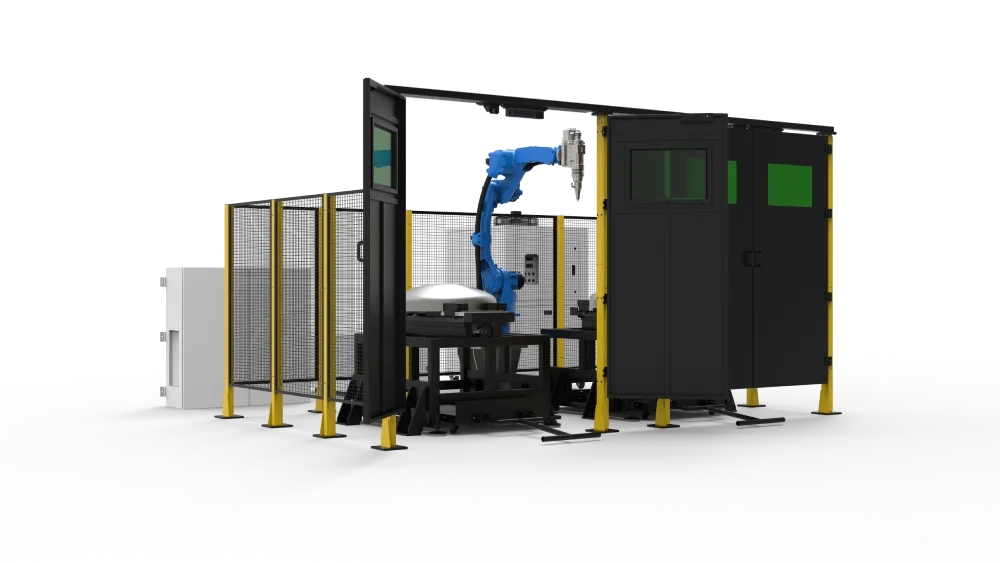
Complex three-dimensional components can be difficult to process using a conventional CNC Laser Cutting Machine. SLTL developed a Robotic Laser Cutting Machine for such applications. The system combines robotic movement with laser processing. This allows the laser head to approach the component from different angles.
As a result, manufacturers can process complex fabricated parts that are difficult to handle using conventional flat-sheet machines.
2. Automated Bearing Marking Machine
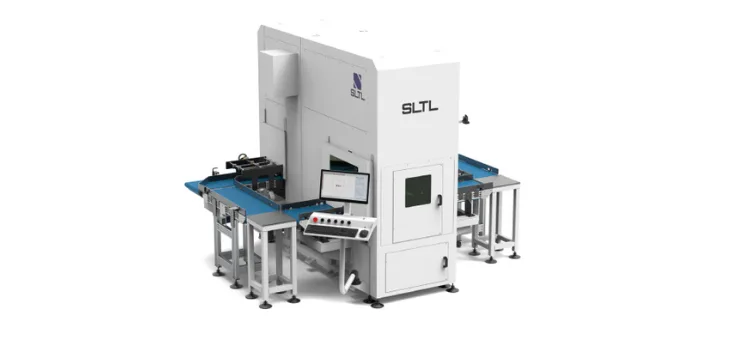
Bearings are generally produced in large quantities. At the same time, manufacturers need permanent identification for traceability. Manual loading and marking can become inefficient when production volume rises.
SLTL developed an Automated Bearing Marking Machine that combines laser marking with automated component handling. This allows bearing marking to become part of a controlled and repetitive production process.
3. Cooker Laser Cutting Machine
Cooker bodies have a completely different geometry from flat sheet metal. Therefore, a standard Best Laser Cutting Machine for Sheet Metal may not be suitable for this application. SLTL developed a dedicated Cooker Laser Cutting Machine around the shape and production requirements of cooker bodies.
This is a good example of how SPM engineering works. Instead of changing the product around a standard machine, the machine is designed around the product.
4. Long Chassis Laser Cutting Machine
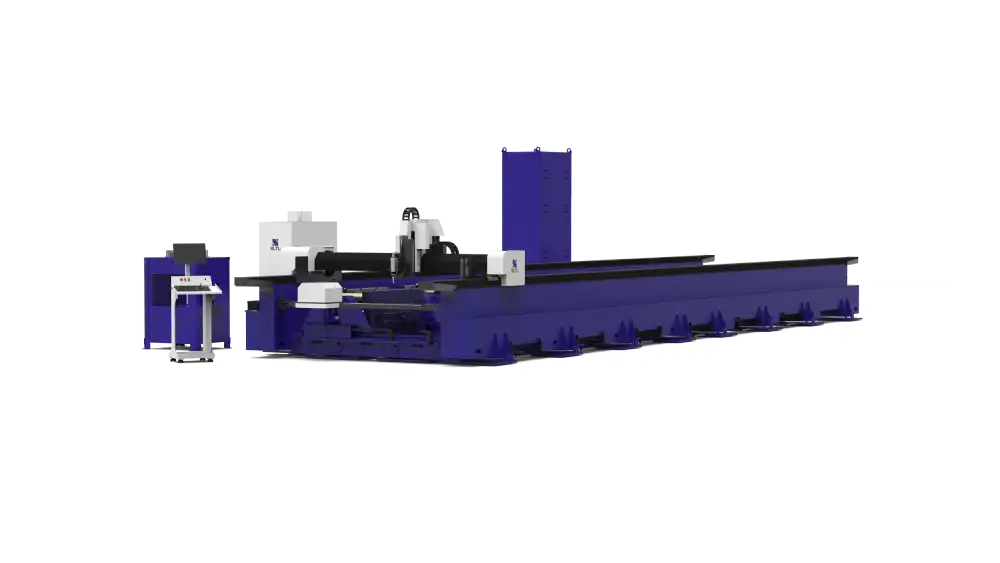
Truck chassis, C-channels, long members, and bus structures can be much longer than conventional sheet metal. A standard laser cutting machine may therefore create working-length limitations. SLTL developed the Long Chassis Laser Cutting Machine to process extended structural components.
This allows manufacturers to cut long parts in a dedicated setup instead of treating them like conventional sheets.
5. KEG Marking Machine
Industrial KEGs need permanent identification for traceability. Batch details, serial numbers, production information, and other data may need to be marked on cylindrical surfaces. SLTL developed a dedicated KEG Marking Machine to handle these requirement
The system is designed around cylindrical components and repeated marking operations.
6. Piston Ring Laser Marking Machine
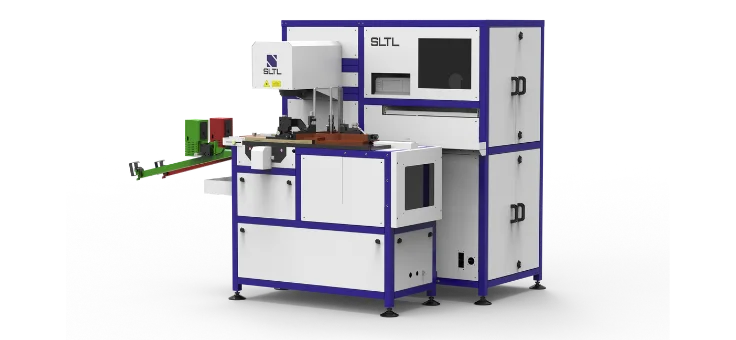
Piston rings are compact automotive parts produced in large quantities. Their geometry makes repetitive marking more difficult than flat component marking. SLTL developed a Piston Ring Laser Marking Machine specifically for this application.
The machine allows manufacturers to automate a process that may otherwise require repeated manual positioning.
7. Laser Marking for Rotary Parts and Name Plates
Manufacturers often need to mark components with different shapes. Some parts are flat, while others are cylindrical. SLTL developed a Special Purpose Machine that can support rotary components and name plate marking. This allows different marking requirements to be managed through one specialized setup.
8. Robotic Head Cutting Machine
Long rectangular tubes and complex three-dimensional profiles can require difficult cutting paths. A conventional CNC cutting machine may not provide the required movement. SLTL developed a Robotic Head Cutting Machine for these applications. The robotic configuration allows the cutting head to move around complex profiles and extended components.
9. Airbag CO₂ Cutting Machine
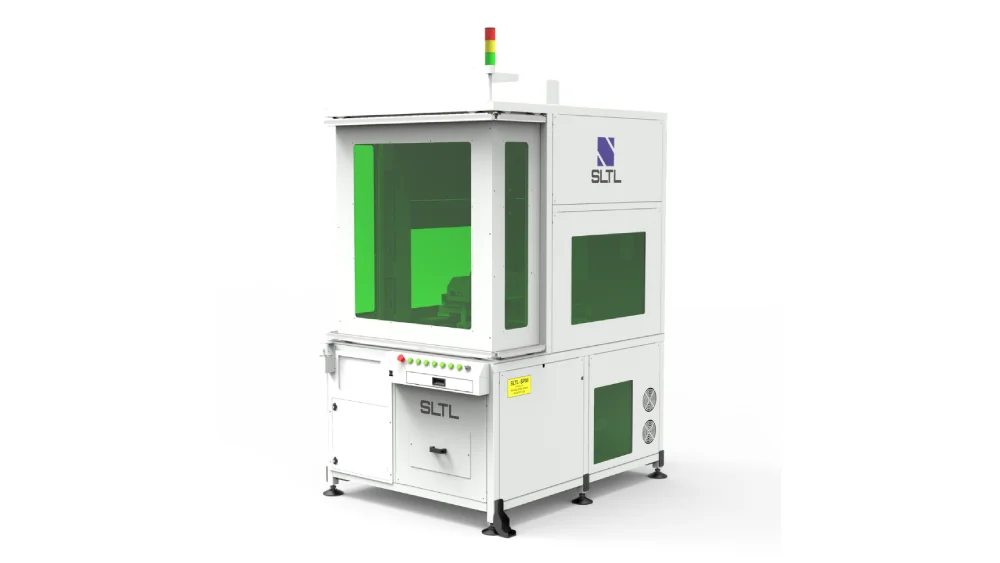
Not every Special Purpose Machine developed by SLTL is focused on metal. Airbag production also creates a specialized cutting requirement. SLTL developed an Airbag CO₂ Cutting Machine using CO₂ laser technology and a dedicated motion system. This shows an important point about SPM development.
The manufacturing problem comes first. The technology is selected after understanding the application.
How Do SLTL’s SPMs Compare?
| Machine | Process | Typical Component | Key Reason for Customization |
|---|---|---|---|
| Robotic Laser Cutting Machine | Laser cutting | Complex 3D parts | Multi-axis movement |
| Automated Bearing Marking Machine | Laser marking | Bearings | High-volume automation |
| Cooker Laser Cutting Machine | Laser cutting | Cooker bodies | Special component geometry |
| Long Chassis Laser Cutting Machine | Laser cutting | Long chassis | Extended working length |
| KEG Marking Machine | Laser marking | KEGs | Cylindrical marking |
| Piston Ring Laser Marking Machine | Laser marking | Piston rings | Small repetitive components |
| Rotary Parts and Name Plates Machine | Laser marking | Flat and rotary parts | Multiple component geometries |
| Robotic Head Cutting Machine | Laser cutting | Tubes and profiles | Complex movement |
| Airbag CO₂ Cutting Machine | CO₂ laser cutting | Airbags | Specialized material processing |
Although these machines look very different, they share the same basic principle. Each machine was developed around a specific manufacturing challenge. That is the real purpose of a Special Purpose Machine.
How Do I Know Whether My Factory Needs an SPM?
Not every manufacturer needs an SPM. For many applications, a standard fiber laser cutting machine, welding system, marking machine, or CNC machine is still the right choice.
However, an SPM may be worth considering when the same production limitation keeps appearing. For example, your component may not fit inside standard machinery. Your process may require too much manual handling. One product may need to move between several machines. You may also need robotic movement, automated loading, special fixtures, or integrated traceability.
In these situations, the question changes. Instead of asking: “Which existing machine should I buy?”
Manufacturers can ask: “What machine should be designed around my process?”
That is where SPM development begins.
What Should Manufacturers Consider Before Investing in an SPM?
Before developing an SPM, manufacturers should first understand the production problem clearly.
| Factor | Question to Ask |
|---|---|
| Production volume | How many parts must be produced per hour or shift? |
| Component geometry | Is the part unusually long, curved, cylindrical, or complex? |
| Current bottleneck | Where does production slow down today? |
| Cycle time | How quickly must each component be completed? |
| Manual handling | Which tasks are still operator-dependent? |
| Future changes | Could the product design change later? |
| Factory layout | How much floor space is available? |
| Integration | Must the SPM connect with existing equipment or software? |
These factors help define the scope of the machine. An SPM project should begin with the business problem, not simply with machine specifications.
Can SPMs Reduce Manufacturing Costs?
An SPM can reduce manufacturing costs in the right application. Manual handling may decrease. Cycle time may improve. Repeatability may become better. Several operations may also be combined. However, an SPM usually requires more initial engineering than a standard machine. Therefore, manufacturers should not evaluate the decision only by looking at the machine price.
A better question is: “How much is the current manufacturing problem costing us?”
This includes labour, delays, rework, handling, rejected parts, additional machines, and lost production capacity. That gives manufacturers a better basis for evaluating an SPM.
Why Choose SLTL Group for Special Purpose Machines?
Developing an SPM requires more than manufacturing a machine frame. The supplier must first understand the production problem. Mechanical engineering, automation, software, motion systems, laser technology, sensors, robotics, and safety systems may all need to work together.
SLTL brings experience across these areas. The company has already developed SPMs for robotic cutting, bearing marking, cooker cutting, long chassis processing, KEG marking, piston ring marking, rotary marking, robotic head cutting, and airbag cutting. Therefore, SLTL’s role is not limited to modifying an existing laser cutting machine.
The process starts with understanding what the manufacturer is trying to achieve. The machine is then developed around that requirement.
What Is the Future of Special Purpose Machines?
Standard machines will continue to remain important. A capable CNC Laser Cutting Machine, welding system, marking machine, or general CNC platform can handle many applications efficiently. However, manufacturers will continue to face production requirements that do not fit standard machines.
Products are becoming more specialized. Automation is expanding. Robotics are being adopted more widely. Traceability requirements are also increasing. Therefore, SPMs are likely to work alongside standard machines.
A standard Best Laser Cutting Machine for Sheet Metal may handle regular sheet processing. Meanwhile, an SPM can solve problems involving unusual product geometry, automation, robotic movement, long components, or integrated processes.
For manufacturers, this creates more options. They no longer have to depend only on machines designed for general applications. Machines can increasingly be engineered around the actual manufacturing process.
Frequently Asked Questions
1. How do I know whether I need an SPM or a standard machine?
You may need an SPM when standard machines cannot meet your component size, process, automation, cycle time, or production volume requirements.
2. Can SLTL develop an SPM for my specific manufacturing process?
Yes. SLTL can study your component, process, cycle time, and automation needs to develop a machine suited to your production challenge.
3. What information should I share before requesting an SPM?
Share component drawings, material, dimensions, production volume, cycle time, current process, quality needs, factory space, and integration details.
4. Can an SPM combine cutting, marking, inspection, and material handling?
Yes. An SPM can combine loading, positioning, cutting, marking, inspection, and unloading when the application and production flow allow it.
5. Can SLTL build an SPM using laser cutting or marking technology?
Yes. SLTL can develop SPMs using laser cutting, marking, welding, robotics, CNC movement, automation, and suitable laser sources.
6. Is an SPM suitable for high-volume production?
Yes. SPMs are suitable for repetitive, high-volume production where automation, shorter cycle times, and consistent output are required.
7. Can an SPM reduce my dependency on manual labour?
Yes. An SPM can automate loading, positioning, processing, inspection, and unloading, depending on your production process and requirements.
8. How much does a Special Purpose Machine cost?
SPM cost depends on machine size, automation, robotics, laser source, fixtures, software, safety systems, and integration requirements.
9. How long does it take to develop a Special Purpose Machine?
The timeline depends on project complexity, machine size, automation level, testing needs, and integration requirements.
10. Can an SPM be integrated with my existing production line?
Yes. An SPM can connect with conveyors, robots, ERP, MES, and other factory systems when integration needs are defined early.
11. Can SLTL conduct trials before I invest in an SPM?
Application trials may be possible based on your material, component, process, and expected output. Share samples and drawings for evaluation.
12. Will an SPM support future product changes?
Some flexibility can be added through adjustable fixtures, software, interchangeable tools, and programmable movement when planned early.
13. What industries can order customized SPMs from SLTL?
SLTL can evaluate SPM needs for automotive, metal fabrication, bearings, cookware, tubes, heavy engineering, traceability, and other industries.
14. Why should I choose SLTL for my SPM project?
SLTL combines laser, robotics, automation, software, and application experience to develop machines around real manufacturing challenges.
What If the Machine You Need Does Not Exist Yet?
Sometimes, manufacturers do not need another standard machine. They need a machine designed differently. Your component may be too long. Your existing process may require too much manual work. You may need robotic processing or several operations inside one production system. In these situations, a Special Purpose Machine may provide a better solution. SLTL Group works with manufacturers to understand these challenges and develop purpose-built systems, to know more contact us today at +91 9925036495 or mail at mkt@SLTL.com.
Your production process does not always have to adjust to an existing machine. Sometimes, the machine can be engineered around your process.
Author Bio

Mayank Patel
R&D HeadMayank Patel is the Head of Research & Development at SLTL Group, bringing over 20+ years of hands-on experience in the field of laser technology. A forward-thinking innovator, he has played a pivotal role in developing advanced laser cutting, welding, and marking solutions tailored for diverse industries. Under his leadership, SLTL’s R&D division continues to push the boundaries of what laser systems can achieve in modern manufacturing.