Still relying on traditional fabrication methods for your PEB projects? You could be losing speed, accuracy, and profits. See how fiber laser cutting is helping leading manufacturers deliver industrial, commercial, and warehouse projects faster with less waste and higher precision.
The growth of modern PEB manufacturing has transformed how industrial, commercial, and warehousing structures are designed and built. Pre-Engineered Buildings are now preferred for projects that demand faster construction, lower lifecycle cost, structural flexibility, and scalable expansion. However, the success of these projects depends heavily on fabrication quality, dimensional accuracy, and production speed.
This is where fiber laser cutting technology has become a major advantage. By delivering high-speed, high-precision steel processing, fiber laser systems help manufacturers produce structural and connection components with excellent consistency. Whether it is a heavy-duty industrial plant, a retail showroom, or a logistics warehouse, fiber laser cutting improves fabrication performance at every stage.
Across modern PEB manufacturing, fiber laser cutting is no longer limited to basic sheet processing. It is now widely used for structural plates, connection parts, support brackets, cladding accessories, secondary members, and custom architectural elements. Its versatility makes it one of the most valuable technologies in PEB production.
Before diving deeper into specific applications, manufacturers new to this sector can explore What is a Pre-Engineered Building (PEB)? A Complete Guide to understand how modern PEB structures are designed, fabricated, and assembled for maximum efficiency.
Why Fiber Laser Cutting Matters in PEB Projects
Different PEB projects require different structural layouts, spans, loading conditions, and finishing requirements. Traditional fabrication methods often struggle to balance speed with precision. Fiber laser cutting addresses this challenge through:
- Tight dimensional tolerances
- Faster production cycles
- Clean and burr-free edges
- Minimal heat distortion
- Capability for complex geometries
- Better material utilization
These advantages support multiple project categories within PEB manufacturing.
In addition, structural accuracy starts with proper material selection and engineering practices. Manufacturers can gain deeper insights by reading Understanding Structural Steel Requirements in PEB Systems, which highlights the role of steel specifications and fabrication precision in successful PEB projects.
Modern laser solutions allow fabricators to process steel with exceptional consistency. Depending on production requirements, companies may utilize a lower power laser cutting machine for thinner materials or a high power laser cutting machine for thick structural plates and heavy-duty applications.
1. Applications in Industrial PEB Projects
Industrial buildings often involve heavy-duty operations, equipment loads, crane systems, and demanding environments. Fabrication quality is therefore critical.
Common Industrial Applications
Manufacturing Plants: Factories require strong structural frames, mezzanine supports, utility platforms, and machinery foundations. Fiber laser cutting is used for:
- Base plates
- Column stiffeners
- Crane beam brackets
- Equipment support plates
- Cable tray supports
Engineering Workshops: Workshops need open spans and flexible layouts. Laser-cut components ensure faster erection and precise alignment.
Process Plants: Facilities such as chemical or food processing plants often need customized platforms, maintenance access systems, and service supports. Fiber laser cutting enables tailored fabrication without long tooling lead times.
Industrial Benefits: For industrial PEB manufacturing, fiber laser technology helps maintain structural accuracy while handling high-volume production schedules.
Many industrial sectors such as Automotive Parts Manufacturing, Tool and Mold Manufacturing, Aerospace, Electronics Manufacturing, and Medical Devices Manufacturing increasingly depend on precision fabrication. These industries require steel structures that support advanced production environments while maintaining strict quality standards.
To further improve assembly quality, manufacturers often integrate a laser welding machine into their fabrication workflow. Additionally, a handheld laser welding machine can support repair work, maintenance activities, and site-level fabrication requirements.
2. Applications in Commercial PEB Projects
Commercial buildings increasingly use PEB systems because of their speed, aesthetics, and cost efficiency. These projects require not only structural performance but also cleaner finishes and architectural flexibility.
Common Commercial Applications
Retail Showrooms: Large front openings, attractive facades, and modern steel detailing are common requirements. Laser cutting supports:
- Decorative façade panels
- Entrance framing components
- Stair brackets and support plates
- Signage structures
Office Buildings: Commercial office spaces often require mezzanine floors, stair systems, HVAC supports, and structured service areas.
Multipurpose Halls: Event spaces, exhibition halls, and community centers benefit from long clear spans and custom structural detailing.
Commercial Benefits: Fiber laser cutting helps manufacturers deliver clean finishes and accurate fabricated parts that reduce visible defects in premium commercial projects.
Many commercial structures also require decorative elements and branding features. A laser engraving machine can be used for signage, identification plates, decorative metal panels, and architectural customization.
The same level of precision is valued in industries such as Jewelry Manufacturing, where laser technologies are widely used for intricate detailing and fine-feature processing.
3. Applications in Warehousing & Logistics Projects
Warehousing is one of the fastest-growing segments in PEB manufacturing, driven by e-commerce, third-party logistics, and supply chain modernization.
Common Warehouse Applications
Distribution Centers: Large-span warehouses require efficient structural framing, docking areas, mezzanine systems, and conveyor supports.
Laser cutting is widely used for:
- Connection plates
- Rack support brackets
- Dock platform steel parts
- Roof and wall support accessories
Cold Storage Buildings: Cold storage warehouses often need insulated panel support systems and precise cladding alignment. Laser-cut components improve installation speed and sealing quality.
Fulfillment Centers: These facilities involve multiple utility integrations and internal steel systems. Customized laser-cut brackets and supports simplify installation.
Warehousing Benefits: In warehouse-focused PEB manufacturing, fiber laser cutting supports fast project execution, scalable expansion, and accurate high-volume component production.
The benefits explained in Advantages of Fiber Laser Cutting in PEB Steel Fabrication further demonstrate why laser systems have become essential for warehouse fabrication projects requiring speed, accuracy, and repeatability.
4. Structural Components Commonly Processed by Fiber Laser
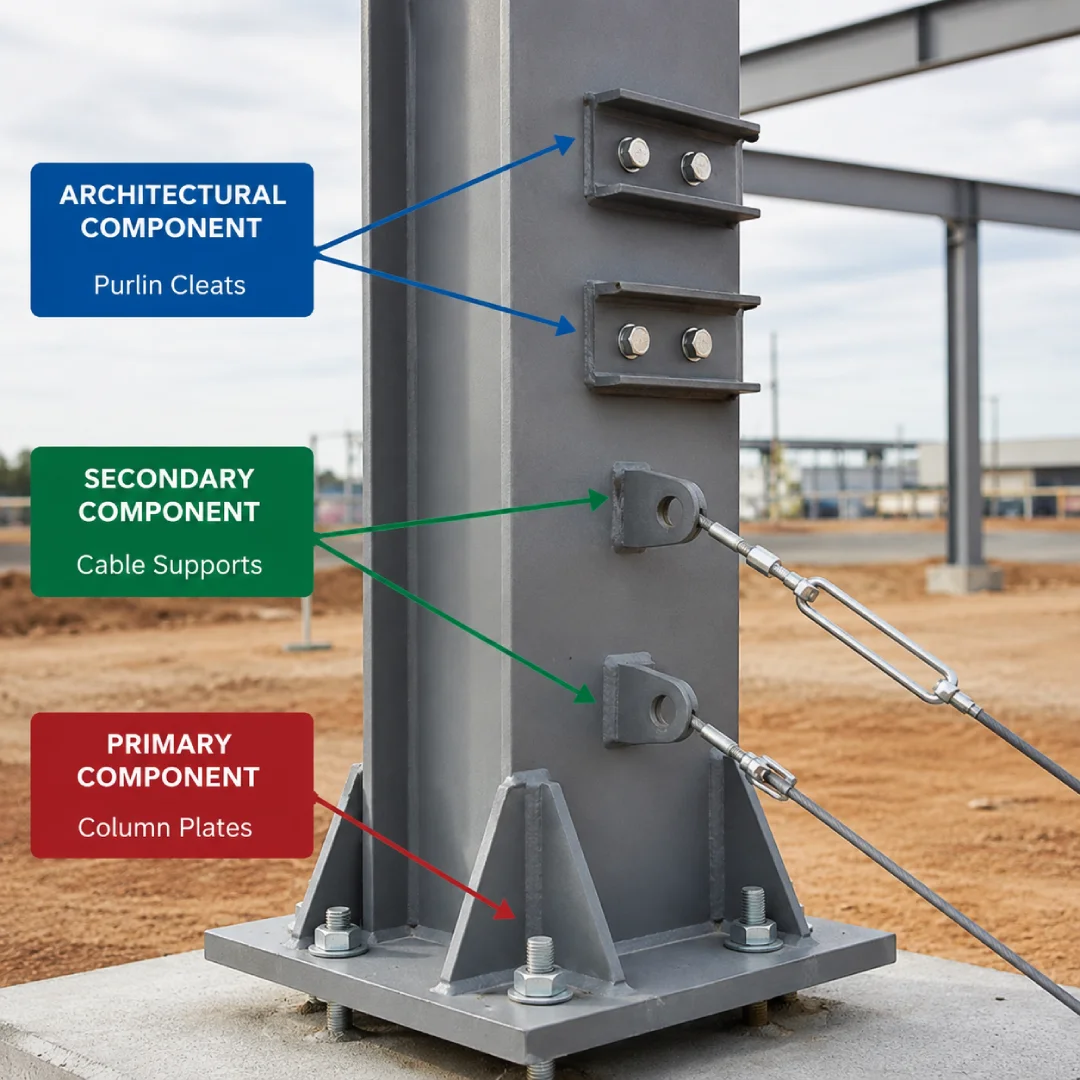
Across industrial, commercial, and warehousing projects, fiber laser cutting is used for a wide range of components.
Primary Component Support Parts
- Column plates
- Rafter connection plates
- Web stiffeners
- Flange inserts
Secondary Members
- Purlin cleats
- Girt brackets
- Bracing gussets
- Eave connection plates
Architectural & Utility Components
- Cable supports
- Stair brackets
- Handrail plates
- Decorative screens
- HVAC support frames
This broad application range makes fiber laser systems highly valuable in PEB manufacturing.
5. Benefits Across All Project Categories
- Speed of Fabrication: Projects with aggressive timelines benefit from faster cut cycles and reduced downstream finishing.
- Repeatability: Large projects often require hundreds of identical parts. Fiber laser systems ensure uniform quality.
- Lower Rework: Precise cutting reduces site modifications and fitment issues.
- Customization: Unique layouts or client-specific design changes can be handled quickly through software-based programming.
- Material Savings: Optimized nesting lowers scrap, improving profitability.
Manufacturers looking to maximize raw material utilization should explore Material Optimization & Nesting Efficiency in PEB Production. Better nesting strategies help reduce waste while improving overall fabrication efficiency.
Furthermore, many fabricators now combine cutting, welding, and marking technologies into a unified workflow. The benefits of this approach are discussed in How Combining Laser Cutting, Welding and Marking Machine Reduces Operational Costs, where integrated production systems help streamline operations and reduce overall manufacturing expenses.
For businesses evaluating a complete laser solution, SLTL offers advanced laser cutting machines, laser welding machines, laser engraving machines, and automation systems designed specifically for modern fabrication industries.
For more info, contact SLTL at +91 99250 36495 or email mkt@sltl.com.
6. Role in Fast-Track Construction Projects
Many industrial and warehouse projects are deadline-driven. Delays in fabrication directly affect commissioning schedules.
Fiber laser cutting helps fast-track PEB manufacturing by:
- Reducing cutting cycle time
- Combining cutting and hole making in one process
- Improving dispatch readiness
- Minimizing correction work at site
This is especially valuable for urgent expansions and turnkey projects.
The Construction industry continues to adopt laser-based fabrication technologies because of their ability to improve project timelines while maintaining quality standards.
7. Integration with Smart Fabrication Systems
Modern PEB plants increasingly connect fiber laser systems with:
- CAD/CAM design platforms
- ERP production planning
- Automated loading systems
- Laser marking for traceability
- Robotic welding cells
This creates a more efficient and scalable production model for high-demand markets.
Today’s smart factories often combine:
- Laser cutting machine technology
- High power laser cutting machine systems
- Lower power laser cutting machine solutions
- Laser welding machine systems
- Handheld laser welding machine technology
- Laser engraving machine applications
This integrated ecosystem helps fabricators achieve higher throughput and improved production control.
8. Future Scope of Fiber Laser in PEB Projects
The use of fiber laser cutting in PEB manufacturing will continue to expand due to:
- Growth in industrial infrastructure
- Rising demand for logistics parks
- Commercial real estate requiring faster execution
- Demand for cleaner and more accurate fabrication
Higher-power machines and automation will further increase adoption.
As industrial sectors such as Automotive Parts, Aerospace, Electronics, Medical Devices, Tool and Mold Manufacturing, Jewelry, and Construction continue to evolve, the demand for precision fabrication technologies will only increase.
Conclusion
Fiber laser cutting has become a versatile and high-value technology across industrial, commercial, and warehousing PEB projects. Its ability to deliver precision, speed, customization, and material efficiency makes it ideal for the diverse demands of modern PEB manufacturing.
From factory buildings and retail showrooms to logistics hubs and cold storage facilities, fiber laser technology helps manufacturers produce better components, complete projects faster, and maintain consistent quality. As construction expectations continue to rise, its role in the future of PEB fabrication will only become stronger.
Whether you are looking for a laser cutting machine, a high power laser cutting machine, a lower power laser cutting machine, a laser engraving machine, a laser welding machine, or a handheld laser welding machine, choosing the right laser solution can significantly improve fabrication quality and productivity.
SLTL provides advanced fiber laser cutting, welding, marking, and automation solutions designed for modern PEB manufacturing facilities.
For more information, contact us today at +91 99250 36495 or email us at mkt@sltl.com. You can also visit at www.sltl.com to know about our products in details.
FAQs
1. How do I know if a fiber laser cutting machine is the right investment for my PEB fabrication business?
If you handle structural plates, connection parts, brackets, and high-volume steel fabrication, you can significantly improve accuracy, speed, and material utilization with a fiber laser cutting machine. It can help you reduce production costs and complete projects faster.
2. I am facing fitment issues during PEB structure assembly. Can fiber laser cutting solve this problem?
Yes. You can achieve highly accurate cuts and hole positions with fiber laser technology. This helps your fabricated parts fit correctly during assembly, reducing rework and site modifications.
3. My current cutting process is slowing down project delivery. How can a laser cutting machine help?
You can reduce cutting time considerably because a fiber laser cutting machine processes parts faster while maintaining consistent quality. This helps you meet tight project deadlines and improve overall production flow.
4. Can I use one laser cutting machine for industrial, commercial, and warehouse PEB projects?
Yes. You can process a wide variety of components for different PEB applications using the same machine. Whether you manufacture industrial structures, commercial buildings, or warehouses, the machine can support multiple fabrication requirements.
5. I want to reduce raw material waste in my PEB plant. Will fiber laser cutting help?
Yes. You can use advanced nesting software with fiber laser cutting to maximize sheet utilization. This helps you reduce scrap generation and improve profitability on every project.
6. How can I improve the quality of welded PEB components after cutting?
You can combine a fiber laser cutting machine with a laser welding machine. Clean and accurate laser-cut edges help you achieve better weld quality, stronger joints, and improved finished products.
7. I am planning to expand my fabrication capacity. Should I choose a high-power laser cutting machine?
If you regularly process thicker structural steel and larger production volumes, you can benefit from a high-power laser cutting machine. It allows you to handle demanding workloads while maintaining productivity.
8. Can fiber laser cutting help me handle custom PEB projects more efficiently?
Yes. You can quickly modify designs through software without changing physical tooling. This allows you to produce customized parts faster and respond to client requirements more effectively.
9. How do I track and identify fabricated components throughout production?
You can integrate a laser marking or laser engraving machine into your workflow. This helps you mark part numbers, project details, QR codes, and identification data for better traceability.
10. Why should I choose SLTL for my PEB laser cutting requirements?
You can get access to advanced laser cutting, welding, marking, and automation solutions designed for modern fabrication facilities. SLTL also provides application support, industry expertise, and machine options suitable for different production requirements.
Author Bio

Mayank Patel
R&D HeadMayank Patel is the Head of Research & Development at SLTL Group, bringing over 20+ years of hands-on experience in the field of laser technology. A forward-thinking innovator, he has played a pivotal role in developing advanced laser cutting, welding, and marking solutions tailored for diverse industries. Under his leadership, SLTL’s R&D division continues to push the boundaries of what laser systems can achieve in modern manufacturing.