Fender panel production is getting more complex, and outdated cutting methods can increase rework, waste, and delays. See how 5-axis fiber laser cutting helps manufacturers improve speed, accuracy, and consistency before competitors move ahead.
Automotive manufacturing is evolving rapidly. Manufacturers are expected to produce lighter vehicles, integrate advanced safety features, and accommodate increasingly complex body designs without compromising production efficiency. Components such as fender panels, once considered relatively straightforward to manufacture, now demand exceptional dimensional accuracy, smooth edge quality, and consistent repeatability.
Meeting these expectations requires more than conventional sheet metal processing. Modern production environments need intelligent manufacturing technologies capable of processing complex geometries with speed and precision while supporting flexible production for multiple vehicle models.
This is where Laser Cutting Machines have become an essential part of automotive manufacturing. By combining high-speed fiber laser technology with advanced motion control and automation, manufacturers can produce precision fender panels with reduced material waste, shorter production cycles, and superior quality.
For complex three-dimensional automotive components, solutions such as the SLTL X5 5-Axis Fiber Laser Cutting Machine extend these capabilities even further, enabling manufacturers to process formed parts with exceptional accuracy and consistency.
Quick Engineering Insight
Modern automotive fender panels are no longer simple sheet metal components. Their complex contours, mounting interfaces, reinforcement sections, and lightweight material requirements demand manufacturing technologies capable of maintaining tight tolerances across three-dimensional surfaces. Five-axis fiber laser cutting enables manufacturers to achieve this level of precision while improving productivity, reducing scrap, and supporting Industry 4.0 manufacturing environments.
Table of Contents
- The Changing Role of Fender Panels in Modern Vehicle Design
- Manufacturing Challenges in Fender Panel Production
- Why Conventional Cutting Methods Are Reaching Their Limits
- The Shift Toward Fiber Laser Processing
- Inside the Fender Panel Manufacturing Workflow
- Why Five-Axis Processing Matters
- How the SLTL X5 Addresses Modern Manufacturing Challenges
- Business Benefits for Automotive Manufacturers
- Future Trends in Automotive Body Panel Manufacturing
- Engineering Takeaways
- FAQs
- Conclusion
The Changing Role of Fender Panels in Modern Vehicle Design
Fender panels serve as both functional and aesthetic components within a vehicle’s body structure. Positioned around the wheel arches, they protect the vehicle from debris while contributing to aerodynamic performance, structural integration, and exterior styling.
As automotive manufacturers move toward lightweight construction and electric vehicle platforms, fender panel designs have become increasingly sophisticated. Today’s panels often incorporate complex curves, mounting provisions for sensors, integrated reinforcement features, and tighter assembly tolerances than ever before.
These evolving requirements place greater demands on manufacturing processes. Every cut, opening, and profile must align precisely with adjoining components to ensure efficient assembly, consistent quality, and long-term vehicle performance.
Why Precision Matters
Unlike structural parts hidden within the vehicle, fender panels remain highly visible after assembly. Even minor dimensional variations can lead to uneven panel gaps, misalignment, or additional rework during production.
High-precision cutting helps manufacturers achieve:
- Accurate dimensional consistency
- Better fit during assembly
- Smooth edge quality with minimal finishing
- Improved welding and joining performance
- Reduced rejection rates
- Faster production throughput
- Consistent product quality across production batches
For manufacturers operating high-volume assembly lines, these improvements translate directly into lower production costs and higher operational efficiency.
Manufacturing Challenges in Fe
Automotive manufacturers face increasing pressure to improve productivity while maintaining exceptional quality standards. Several production challenges influence the efficiency of fender panel manufacturing.
- Complex Component Geometry: Modern fender panels feature intricate contours, wheel arch profiles, mounting brackets, reinforcement openings, and styling elements. These geometries require cutting systems capable of maintaining accuracy across both flat and formed surfaces.
-

Lightweight Material Processing: To improve fuel efficiency and extend electric vehicle range, manufacturers increasingly use lightweight materials such as aluminum and advanced high-strength
steels. These materials require controlled heat input and precise processing to preserve their mechanical properties. - Production Flexibility: Vehicle platforms continue to diversify, resulting in more model variants and shorter product life cycles. Manufacturers require flexible manufacturing systems that can a adapt quickly without extensive tooling changes.
- Maintaining Assembly Accuracy: Every dimensional deviation introduced during cutting can affect downstream forming, welding, and final vehicle assembly. Maintaining consistent tolerances is essential for minimizing production delays and ensuring reliable fitment.
- Reducing Manufacturing Costs: Manufacturers continually seek opportunities to reduce material waste, minimize secondary operations, and improve machine utilization without compromising product quality.
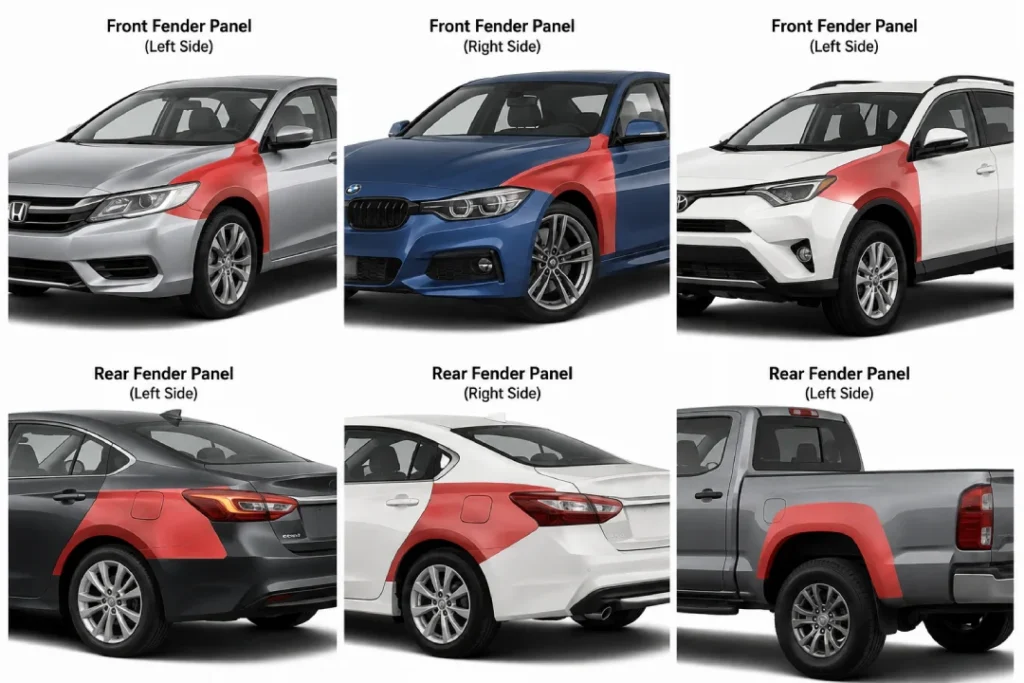
Engineering Perspective: Why Conventional Cutting Methods Are Reaching Their Limits
For decades, automotive manufacturers relied on mechanical trimming, punching, plasma cutting, and dedicated tooling to produce body panels. While these methods remain suitable for certain applications, they present limitations when manufacturing increasingly complex automotive components.
Mechanical tooling requires dedicated dies for each component, reducing flexibility when design changes occur. Plasma cutting makes larger heat-affected zones, which may require additional finishing and can influence material quality. Manual trimming often depends on operator skill, making consistent repeatability more difficult to achieve.
As vehicle designs become more sophisticated, these challenges increase production complexity, extend cycle times, and contribute to higher operating costs. Modern manufacturing therefore requires processing technologies capable of combining precision, flexibility, and automation within a single production platform.
Why Fiber Laser Cutting Has Become the Preferred Manufacturing Process
Fiber laser technology addresses many of the limitations associated with conventional cutting methods by combining high energy density, intelligent motion control, and advanced automation.
Instead of relying on mechanical contact, a focused laser beam melts or vaporizes material along a programmed path. This enables highly accurate cutting with minimal thermal impact on surrounding material.
For automotive manufacturers, the advantages extend well beyond cutting speed.
- Improved Dimensional Accuracy: Highly focused laser beams enable precise profile generation with tight tolerances, supporting better assembly quality and reducing rework.
- Superior Edge Quality: Laser-cut edges are smooth and burr-free, minimizing secondary finishing operations and improving downstream productivity.
- Higher Material Utilization: Advanced nesting software optimizes sheet layouts, reducing scrap and improving raw material efficiency.
- Greater Manufacturing Flexibility: Unlike conventional tooling, laser programs can be modified digitally, allowing manufacturers to accommodate new vehicle designs with minimal production disruption.
- Automation Compatibility: Fiber laser systems integrate seamlessly with robotic loading, automated material handling, and smart factory environments, supporting continuous production and Industry 4.0 initiatives.
These benefits also support structural fabrication. Read our guide to PEB manufacturing to see how fiber laser cutting improves speed, accuracy, and material use.
Inside the Fender Panel Manufacturing Workflow
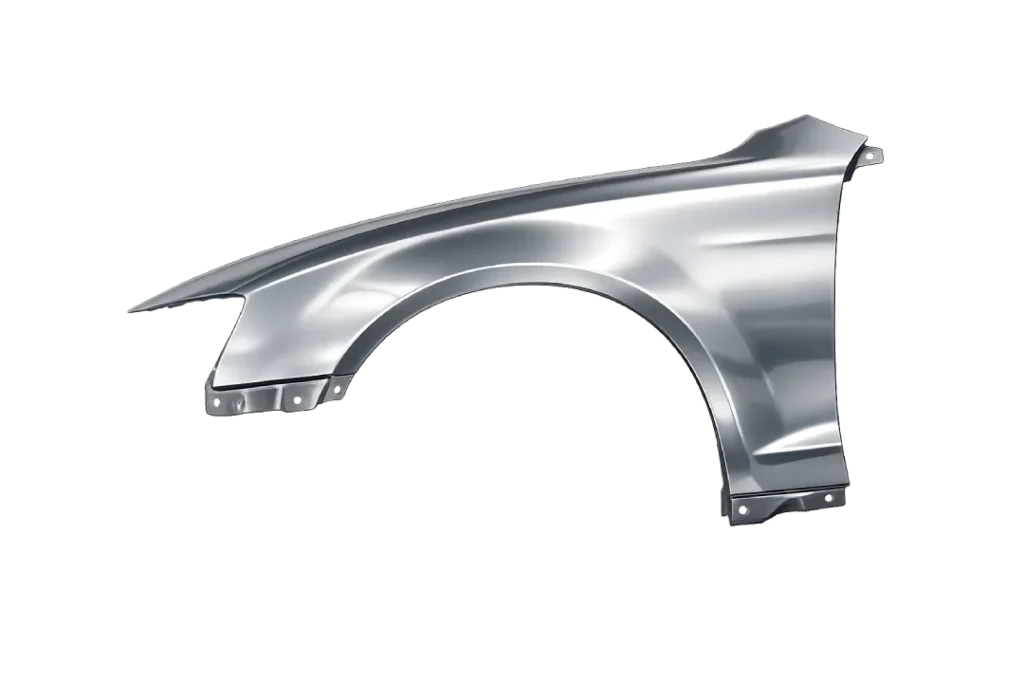
Fender Panel of a Car
Modern fender panel production follows a highly coordinated manufacturing sequence where precision at every stage influences final product quality.
Stage 1: Digital Product Design
Engineers create detailed CAD models that define panel geometry, mounting locations, reinforcement features, and dimensional tolerances.
Stage 2: Material Preparation
Appropriate sheet materials-such as aluminum, mild steel, or advanced high-strength steel-are selected based on vehicle design requirements and prepared for processing.
Stage 3: Precision Laser Cutting
Using advanced Fiber Laser Cutting Machines, the sheet is cut into the required profile, including mounting holes, slots, complex contours, and functional openings with exceptional accuracy.
Stage 4: Forming and Shaping
The laser-cut blank undergoes forming operations to achieve the final three-dimensional shape while maintaining dimensional integrity.
Stage 5: Inspection and Assembly
Finished components are inspected for dimensional accuracy before moving to welding, painting, and final vehicle assembly.
Why Five-Axis Processing Matters in Automotive Manufacturing
Automotive body components are no longer manufactured as simple flat profiles. Today’s fender panels feature complex curves, embossed sections, mounting interfaces, reinforcement openings, and varying surface angles that demand precise processing after forming.
Conventional two-dimensional cutting systems are well suited for flat sheet processing, but they become limited when components require machining across multiple planes. Manufacturers often compensate by introducing additional fixtures, manual repositioning, or secondary machining operations. These extra steps increase production time, reduce repeatability, and introduce opportunities for dimensional variation.
Five-axis laser processing addresses these challenges by allowing the laser head to move simultaneously along multiple axes while maintaining the correct orientation relative to the component surface. This ensures that the laser beam remains accurately focused, even when cutting intricate three-dimensional geometries. For automotive manufacturers, this capability results in improved dimensional consistency, reduced setup time, and greater flexibility when producing multiple vehicle variants.
Engineering Insight
A five-axis laser system does more than move in additional directions. It continuously adjusts the laser beam’s position and angle to maintain optimal cutting conditions across complex surfaces, ensuring consistent quality from the first component to the last.
The Engineering Behind Precision Laser Processing
The quality of a laser-cut component depends on much more than laser power. Several engineering parameters work together to determine the final result.
Beam Stability: A stable laser beam ensures uniform energy distribution throughout the cutting process. Consistent beam quality helps maintain accurate kerf width, smooth edge finishes, and repeatable dimensional accuracy across production batches.
Motion Control: Modern servo-driven motion systems synchronize machine movement with laser output, enabling smooth acceleration, controlled deceleration, and accurate positioning even during complex cutting paths.
Precise motion control reduces vibration, improves contour accuracy, and supports higher cutting speeds without compromising quality.
Focus Management: Maintaining the correct focal position is essential when processing three-dimensional automotive components.
Variations in focus can affect:
- Edge quality
- Surface finish
- Heat input
- Dimensional accuracy
Advanced focus control systems continuously adjust the focal point, ensuring stable cutting conditions throughout the machining process.
Assist Gas Optimization: Assist gases play an important role in laser cutting by removing molten material from the cutting zone and protecting the cut edge.
Selecting the appropriate gas and pressure contributes to:
- Cleaner cut surfaces
- Reduced oxidation
- Better edge finish
- Improved productivity
How the SLTL X5 Addresses Modern Manufacturing Challenges
Rather than simply introducing advanced features, the SLTL X5 has been engineered to solve practical manufacturing challenges faced by automotive producers.
Accurate Cutting on Formed Automotive Components
- Manufacturing Challenge: Modern fender panels often require machining after forming. Processing holes, slots, and intricate contours on curved surfaces while maintaining dimensional accuracy can be challenging with conventional equipment.
- Engineering Solution: The SLTL X5 combines simultaneous five-axis movement with Tool Center Point (TCP) technology. This enables the laser head to maintain the correct orientation and focal distance throughout the cutting process, even on complex geometries.
- Production Benefit: Manufacturers achieve consistent edge quality, improved dimensional accuracy, and fewer secondary operations, resulting in faster production and better assembly performance.
Supporting Flexible Vehicle Production
Manufacturing Challenge
Automotive manufacturers frequently introduce new vehicle models and design updates. Dedicated tooling can limit production flexibility and increase changeover time.
- Engineering Solution: The X5 processes components directly from digital CAD data, reducing dependence on dedicated trimming tools and enabling rapid adaptation to design changes.
- Production Benefit: Shorter development cycles, faster product introductions, and greater manufacturing flexibility.
Improving Production Efficiency
- Manufacturing Challenge: Manufacturers seek to increase output without expanding production space or adding unnecessary labour.
- Engineering Solution: High-speed motion control, intelligent laser processing, and optimized cutting strategies reduce overall cycle time while maintaining consistent quality.
- Production Benefit: Higher throughput, improved machine utilization, and lower cost per component.
Industry 4.0 Integration
- Manufacturing Challenge: Modern factories require production data to optimize machine performance, maintenance schedules, and operational efficiency.
- Engineering Solution: The SLTL X5 integrates with Industry 4.0 manufacturing environments, enabling real-time monitoring, production analytics, and machine diagnostics.
- Production Benefit: Greater production visibility, predictive maintenance opportunities, and improved operational decision-making.
Comparing Conventional and Five-Axis Fiber Laser Processing
| Manufacturing Parameter | Conventional Processing | Five-Axis Fiber Laser Processing |
|---|---|---|
| Component Complexity | Limited | Excellent |
| Dimensional Accuracy | Moderate | High |
| Cutting on Formed Parts | Multiple Setups Required | Single Integrated Process |
| Secondary Operations | Higher | Reduced |
| Changeover Time | Longer | Shorter |
| Production Flexibility | Limited | High |
| Material Utilization | Moderate | Optimized |
| Automation Compatibility | Partial | Full |
| Repeatability | Moderate | Excellent |
For manufacturers producing complex automotive components, five-axis laser processing offers a more efficient and scalable production approach.
Manufacturing Value Beyond the Cutting Process
While cutting quality is essential, manufacturers evaluate equipment based on its impact across the entire production line.
The implementation of advanced laser processing can improve several key manufacturing indicators.
- Reduced Cost Per Component: Improved material utilization, fewer secondary operations, and shorter cycle times contribute to lower manufacturing costs.
- Better Overall Equipment Effectiveness (OEE): Reliable machine performance, reduced downtime, and efficient production scheduling help maximize equipment utilization.
- Improved Assembly Quality: Consistent dimensional accuracy reduces alignment issues during downstream assembly operations.
- Enhanced Production Flexibility: Digital programming enables manufacturers to respond quickly to design revisions and changing customer requirements.
- Lower Material Waste: Optimized nesting and precise cutting reduce scrap, improving raw material efficiency and supporting sustainability goals.
Applications Beyond Fender Panels
Although this article focuses on fender panel manufacturing, five-axis fiber laser technology supports a wide range of automotive applications. Typical components include:
- Door Inner Panels
- Tailgate Panels
- Roof Rails
- B-Pillars
- Chassis Components
- Battery Enclosures
- Seat Frames
- Suspension Brackets
- Cross Members
- Engine Bay Components
- Structural Reinforcement Parts
The ability to process both flat and formed components makes five-axis laser systems suitable for a variety of production requirements.
For another automotive example, read our guide to 3-Wheeler Rickshaw Manufacturing. It explains how cutting, tube processing, marking, and welding work together.
Future Trends in Automotive Body Manufacturing
The automotive industry continues to evolve toward more intelligent, connected, and sustainable manufacturing.
Several trends are influencing body panel production.
- Lightweight Vehicle Design: Manufacturers increasingly use advanced high-strength steels and aluminum alloys to reduce vehicle weight while maintaining structural performance.
- Electric Vehicle Manufacturing: EV platforms introduce new body architectures that require greater manufacturing flexibility and higher precision.
- Smart Factories: Connected manufacturing systems provide real-time production data, improving process optimization and equipment utilization.
- Automated Quality Inspection: Digital inspection systems combined with precision manufacturing help maintain consistent quality across high-volume production.
- Sustainable Manufacturing: Reducing material waste, improving energy efficiency, and optimizing production resources have become important priorities for manufacturers worldwide.
Fiber laser technology supports these objectives through efficient material utilization and reduced secondary processing.
Engineering Takeaways
Manufacturing requirements for automotive body panels continue to become more demanding as vehicle designs evolve and production expectations increase. Five-axis fiber laser processing provides manufacturers with the flexibility and precision required to meet these challenges while supporting efficient, data-driven production.
With more than 37 years of engineering expertise, SLTL Group continues to develop laser processing solutions that combine precision engineering, intelligent automation, and dependable after-sales support. The SLTL X5 5-Axis Fiber Laser Cutting Machine is designed to help manufacturers process complex automotive components with greater accuracy, shorter cycle times, and improved production consistency.
Whether producing fender panels, structural body components, or electric vehicle parts, manufacturers benefit from a solution that is engineered to support today’s production requirements while remaining adaptable for future manufacturing demands.
Need a Machine Built for Your Process?
Some production needs cannot be handled by a standard machine. In such cases, SLTL can design a Special Purpose Machine (SPM) around your product, process, and production goals. A customized SPM can combine cutting, welding, marking, automation, inspection, or material handling in one solution. This helps reduce manual work, improve consistency, and simplify production.
Read the SLTL Special Purpose Machine (SPM) page to understand how SLTL helps manufacturers solve specific production challenges. You can also contact SLTL Group at +91 99250 36495 to know more about SLTL and how SLTL can help you in your manufacturing process.
Author Bio

Mayank Patel
R&D HeadMayank Patel is the Head of Research & Development at SLTL Group, bringing over 20+ years of hands-on experience in the field of laser technology. A forward-thinking innovator, he has played a pivotal role in developing advanced laser cutting, welding, and marking solutions tailored for diverse industries. Under his leadership, SLTL’s R&D division continues to push the boundaries of what laser systems can achieve in modern manufacturing.