Struggling with slow PEB fabrication and rework issues? See how fiber laser cutting machines improve accuracy, reduce waste, and speed up production. Don’t let outdated methods hold back your growth.
In modern PEB manufacturing, precision, speed, and efficiency are critical factors that directly impact structural quality and project timelines. As explained in What is a Pre-Engineered Building (PEB)? A Complete Guide, these structures depend heavily on factory-made accuracy. As the demand for large-scale industrial buildings, warehouses, and commercial structures continues to grow, manufacturers are increasingly adopting advanced technologies to improve fabrication processes. One such breakthrough technology is the fiber laser cutting machine, which has become a core component of high-performance steel fabrication.
Unlike conventional cutting methods, fiber laser cutting delivers unmatched accuracy, cleaner edges, and faster production speeds. This shift is also discussed in Building Smarter, Faster, Stronger: The Power of Fiber Laser in PEB Manufacturing. This makes it highly suitable for processing structural steel components used in Pre-Engineered Buildings (PEBs), where dimensional accuracy and repeatability are essential for seamless assembly. For deeper understanding, refer to Understanding Structural Steel Requirements in PEB Systems.
What is a Fiber Laser Cutting Machine?
A fiber laser cutting machine is a high-precision metal cutting system that uses a solid-state laser source to generate an intense beam of light. This beam is produced using optical fibers doped with rare-earth elements such as ytterbium and is transmitted through a fiber optic cable to the cutting head.
When the laser beam is focused on the material surface, it generates extremely high energy density, allowing it to melt, burn, or vaporize metal. Assist gases such as oxygen or nitrogen are used to remove molten material and create a clean, precise cut.
In PEB manufacturing, this technology is widely used because it offers:
- High cutting accuracy (up to ±0.05 mm)
- Minimal heat-affected zone (HAZ)
- Smooth, burr-free edges
- High processing speeds
These capabilities make fiber laser cutting superior to traditional methods like plasma and oxy-fuel cutting.
Role of Fiber Laser Cutting Machine in PEB Manufacturing
In PEB manufacturing, steel components are fabricated in a factory and assembled on-site. This requires every component to be produced with exact dimensions and alignment.
Fiber laser cutting machines are used for processing:
- Base plates and end plates
- Gussets and stiffeners
- Columns and rafter plates
- Purlins and girts
- Brackets and connection elements
The precision of fiber laser cutting ensures that all components fit perfectly during assembly, reducing errors and eliminating the need for rework at the construction site.
Working Principle of Fiber Laser Cutting
The working of a fiber laser cutting machine involves three main stages:
- Laser Generation: A laser beam is generated using ytterbium-doped optical fibers, producing a high-energy, stable light source.
- Beam Transmission: The laser is transmitted through a fiber optic cable without significant energy loss, ensuring consistent power delivery.
- Material Cutting: The beam is focused on the steel surface, where it melts or vaporizes the material. Assist gas removes molten metal, resulting in a clean and precise cut.
This process ensures high repeatability and minimal distortion, which is essential in PEB manufacturing. Depending on the application, manufacturers choose between a high power laser cutting machine and a lower power laser cutting machine.
Why Fiber Laser Cutting is Critical in PEB Fabrication
- Precision for Structural Accuracy: PEB structures rely on bolted connections, where even small deviations can lead to misalignment. Fiber laser cutting ensures tight tolerances, enabling perfect fit-up.
- Minimal Heat-Affected Zone: Unlike traditional cutting methods, fiber lasers produce a very small heat-affected zone (typically 0.1-0.3 mm), preserving the mechanical properties of steel.
Advantages of Fiber Laser Cutting Machine in PEB Manufacturing
- Superior Edge Quality: Laser cutting produces smooth edges, eliminating the need for grinding or finishing.
- Reduced Material Waste: Integration with nesting software optimizes material usage and reduces scrap.
- Automation Compatibility: Fiber laser systems can be integrated with CNC, CAD/CAM, and automated handling systems.
- Lower Maintenance: Compared to CO₂ lasers, fiber lasers require less maintenance due to fewer moving parts.
- Energy Efficiency: Fiber lasers offer higher electrical efficiency, reducing operational costs.
Comparison with Traditional Cutting Methods
| Parameter | Oxy-Fuel | Plasma Cutting | Fiber Laser Cutting |
|---|---|---|---|
| Precision | Low | Moderate | Very High |
| Speed | Slow | Fast | Very Fast |
| HAZ | High | Medium | Minimal |
| Edge Quality | Rough | Moderate | Excellent |
| Automation | Limited | Moderate | Advanced |
This comparison highlights why fiber laser cutting is becoming the preferred choice in modern PEB manufacturing.
Integration with Smart Manufacturing (Industry 4.0)
Fiber laser cutting machines are not standalone systems-they are part of a larger smart manufacturing ecosystem.
In advanced PEB manufacturing facilities, they are integrated with:
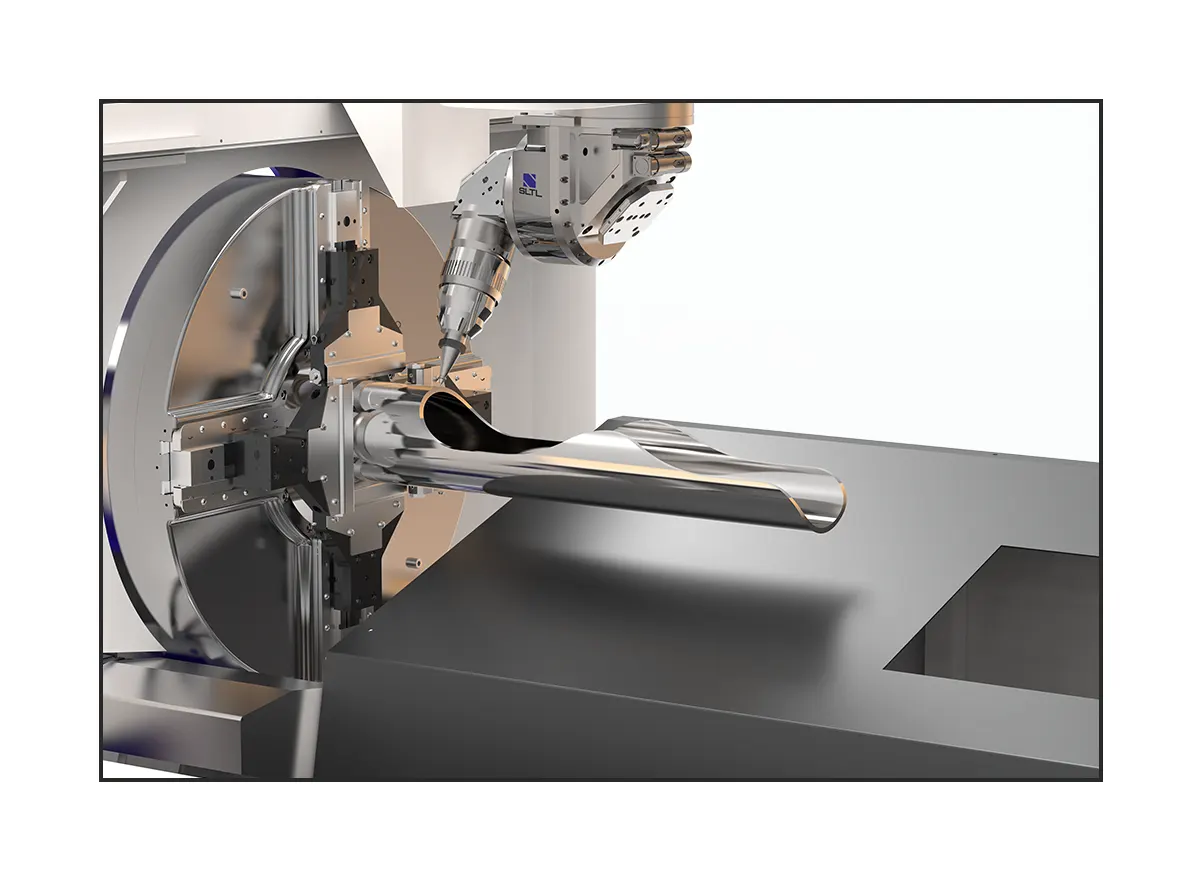
- CAD/CAM software for design-to-production workflow
- Nesting software for material optimization
- IoT systems for real-time monitoring
- Automated loading/unloading systems
Additionally, fiber laser cutting is often combined with:
- Laser marking machine for part identification and traceability
- Laser welding machine and handheld Laser welding machine for strong and flexible joining operations.
This integration enables faster production, better quality control, and improved efficiency.
Applications in PEB Structures
Fiber laser cutting machines are used across various components of PEB systems:
Primary Components
- Columns
- Rafters
- Structural frames
Secondary Components
- Purlins
- Girts
- Bracing elements
Connection Elements
- Base plates
- Gussets
- End plates
Their ability to handle complex geometries makes them ideal for both structural and architectural applications.
Cost Efficiency and ROI
Although the initial investment in a fiber laser cutting machine is high, it offers significant long-term benefits in PEB manufacturing:
- Reduced labor costs due to automation
- Lower material waste
- Faster production cycles
- Minimal maintenance
These factors contribute to faster return on investment (ROI), especially in high-volume production environments.
Challenges in Using Fiber Laser Cutting Machines
Despite its advantages, some challenges include:
- High initial capital investment
- Requirement for skilled operators
- Power and infrastructure needs
- Limitations in cutting very thick materials
However, advancements in high-power laser systems are gradually addressing these challenges.
Future of Fiber Laser Cutting in PEB Manufacturing
The future of fiber laser cutting machines in PEB manufacturing is driven by:
- High-power lasers (20kW and above)
- AI-based process optimization
- Fully automated fabrication lines
- Sustainable and energy-efficient systems
These innovations will further enhance productivity and reduce costs in the PEB industry.
Conclusion
A fiber laser cutting machine is a critical technology in modern PEB manufacturing, enabling precise, fast, and efficient fabrication of structural steel components. Its ability to maintain tight tolerances, reduce material waste, and integrate with automated systems makes it indispensable for high-performance building solutions.
As the construction industry continues to demand faster delivery and higher quality, fiber laser cutting technology will play a central role in shaping the future of PEB fabrication.
If you are planning to upgrade your fabrication process with a high-performance laser cutting machine, SLTL Group can help you with the right solution based on your production needs. You can connect with the team at +919925036495 or write to mkt@sltl.com for expert guidance. You can also explore their complete range of laser solutions on www.sltl.com and request a live demo for your application.
Frequently asked questions (FAQs)
Q1. I am facing fitting issues during PEB assembly, how can I improve accuracy?
When your parts do not fit properly, it usually means cutting accuracy is not consistent. You should use a fiber laser cutting machine, as it gives tight tolerances and ensures every component matches perfectly during assembly.
Q2. My production is slow, how can I speed up fabrication without adding more labor?
If your production is slow, your cutting process may be the bottleneck. You can switch to a CNC laser cutting machine, which increases speed and reduces manual dependency, helping you produce more in less time.
Q3. I see a lot of rework after cutting, what is the solution?
Rework happens when edges are rough or dimensions are not accurate. You should use a laser cutting machine that gives clean and burr-free edges, so your parts are ready for assembly without extra finishing.
Q4. I am losing material due to improper cutting, how can I reduce waste?
Material waste usually comes from poor nesting and uneven cutting. You can use a fiber laser cutting machine with nesting software, which optimizes sheet usage and reduces scrap significantly.
Q5. I want to handle both thin and thick sheets, what type of machine should I choose?
If you work with different thicknesses, you should select based on your needs. You can use a high power laser cutting machine for thick plates and a lower power laser cutting machine for thinner materials and detailed work.
Q6. I need marking and welding also, do I need separate machines?
If you are using separate systems, your process becomes slow and costly. You can combine a laser engraving machine for marking and a laser welding machine or handheld laser welding machine to create a complete and efficient workflow.
Q7. My operators are struggling with traditional machines, is there an easier solution?
Traditional machines require more manual effort and skill. You can move to a CNC laser cutting machine, which is easier to operate, more automated, and gives consistent output with less operator dependency.
Q8. I want to reduce overall production cost, where should I start?
You should start by improving your cutting process. When you use a fiber laser cutting machine, you reduce waste, rework, and labor cost, which directly improves your overall profitability.
Q9. I am planning to scale my fabrication business, what should I invest in?
If you want to scale, you should invest in automation. A modern laser cutting machine with smart integration helps you handle higher volume, maintain quality, and grow your business faster.
Q10. I am not sure if laser technology is worth the investment, how can I decide?
If you compare long-term benefits like speed, accuracy, and lower operating cost, you will see clear value. You should evaluate your current losses and then decide, as a fiber laser cutting machine usually gives faster ROI in high production setups.
Author Bio

Mayank Patel
R&D HeadMayank Patel is the Head of Research & Development at SLTL Group, bringing over 20+ years of hands-on experience in the field of laser technology. A forward-thinking innovator, he has played a pivotal role in developing advanced laser cutting, welding, and marking solutions tailored for diverse industries. Under his leadership, SLTL’s R&D division continues to push the boundaries of what laser systems can achieve in modern manufacturing.