Discover how fiber laser cutting is transforming thresher manufacturing. Boost precision, reduce costs, and speed up production—don’t get left behind as competitors adopt smarter, faster, and more efficient laser solutions today.
The agricultural machinery industry is rapidly evolving, and one of the most important machines in post-harvest farming is the Thresher Machine. A thresher is used to separate grains from harvested crops quickly and efficiently, helping farmers save labor, time, and crop losses. As the demand for durable, high-performance, and precision-built threshers rises, manufacturers are shifting toward advanced fabrication technologies, especially fiber laser cutting.
Traditional fabrication methods such as gas cutting, manual shearing, drilling, and plasma cutting often create dimensional inaccuracies, rough edges, rework, and higher production costs. In contrast, laser cutting technology delivers clean cuts, accurate holes, complex shapes, faster production cycles, and better material utilization. This makes it ideal for manufacturing modern thresher machine parts.
Today, laser cutting plays a major role in producing thresher body panels, feeding trays, rotor covers, sieves, blades, supports, frames, guards, pulleys, and structural components with excellent consistency. Modern manufacturers are now integrating advanced Laser solution systems to improve production quality and reduce fabrication time.
Many agricultural equipment manufacturers are also adopting CNC Laser Cutting Machine systems for faster sheet processing and better repeatability. Depending on production volume and material thickness, companies can choose between a High power laser cutting machine for heavy-duty fabrication or a Lower power laser cutting machine for medium production requirements.
This blog explains in detail how threshers are manufactured, the major parts involved, where laser cutting is used, and why modern thresher manufacturers are investing in laser technology.
Manufacturers looking to modernize agricultural machinery production can also explore advanced laser cutting machine solutions from SLTL Group for high-speed and precision fabrication. For consultation regarding laser fabrication systems for agricultural equipment manufacturing, you can contact SLTL Group at +91 9925036495 or email mkt@sltl.com.
Table of Contents:
1. What is a Thresher Machine?
2. Why Precision Manufacturing Matters in Threshers
3. Importance of Laser Cutting in Thresher Manufacturing
4. Major Parts of a Thresher Machine
5. Laser Cut Components in a Thresher
6. Manufacturing Process of Thresher Using Laser Cutting
7. Benefits of Fiber Laser Cutting for Thresher Parts
8. Material Used in Thresher Production
9. Quality Control in Thresher Manufacturing
10. Productivity Benefits for Manufacturers
11. Future of Smart Thresher Manufacturing
12. Conclusion
What is a Thresher Machine?
A thresher machine is agricultural equipment designed to separate grains from crop stalks, husks, and straw after harvesting. It is widely used for:
- Wheat threshing
- Paddy threshing
- Rice processing
- Maize shelling
- Pulse separation
- Millet and seed crops
Threshers reduce manual labor and improve harvesting speed significantly.
Why Precision Manufacturing Matters in Threshers
Threshers operate at high RPM (Revolutions Per Minute) with rotating drums, blades, shafts, and moving grain flow systems. If parts are inaccurate, common issues occur:
- Excess vibration
- Grain damage
- Noise problems
- Bearing failure
- Misalignment
- Poor threshing efficiency
- Frequent breakdowns
That is why precision manufacturing is critical and laser cutting helps solve these challenges. Many OEMs now prefer Fiber laser cutting machine technology because it ensures consistent part accuracy and better assembly quality for agricultural machinery.
Importance of Laser Cutting in Thresher Manufacturing
Fiber laser cutting machines are widely used in agricultural equipment manufacturing because they can cut steel sheets, plates, tubes, and structural parts with speed and accuracy. Laser cutting is ideal for:
- Complex sheet metal parts
- Hole cutting for bolts and assemblies
- Thin to thick MS sheet cutting
- Repeat production batches
- Clean edges with minimal finishing
- Fast prototype development
For thresher manufacturers, this means better quality machines and lower production cost.
Manufacturers handling long chassis structures and heavy agricultural frames can also benefit from understanding What Is a Long Bed Laser Cutting Machine and Why Does Your Industry Need One? Long bed systems improve large sheet handling and reduce repositioning time during fabrication.
Similarly, manufacturers processing structural pipe components can explore Tube Laser Cutting for Agricultural Machinery and Light Structures to improve tube processing accuracy and reduce manual fabrication.
Major Parts of a Thresher Machine
A thresher machine is designed with multiple mechanical and fabricated components that work together to separate grains from harvested crops efficiently. Each part performs a specific function to ensure smooth crop feeding, proper threshing, cleaning, and grain collection. Precision manufacturing and strong structural design are essential because threshers operate continuously under heavy agricultural loads and high rotational speeds. Below are the major parts of a thresher machine in detail:
1. Feeding Hopper
The feeding hopper is the entry section of the thresher where harvested crops are manually or automatically fed into the machine. It is generally fabricated using sheet metal and designed with a wide opening for easy crop handling. The hopper ensures uniform feeding of crop bundles into the threshing chamber, preventing overloading and blockage. Proper hopper design improves operator safety and enhances machine efficiency during continuous operations.
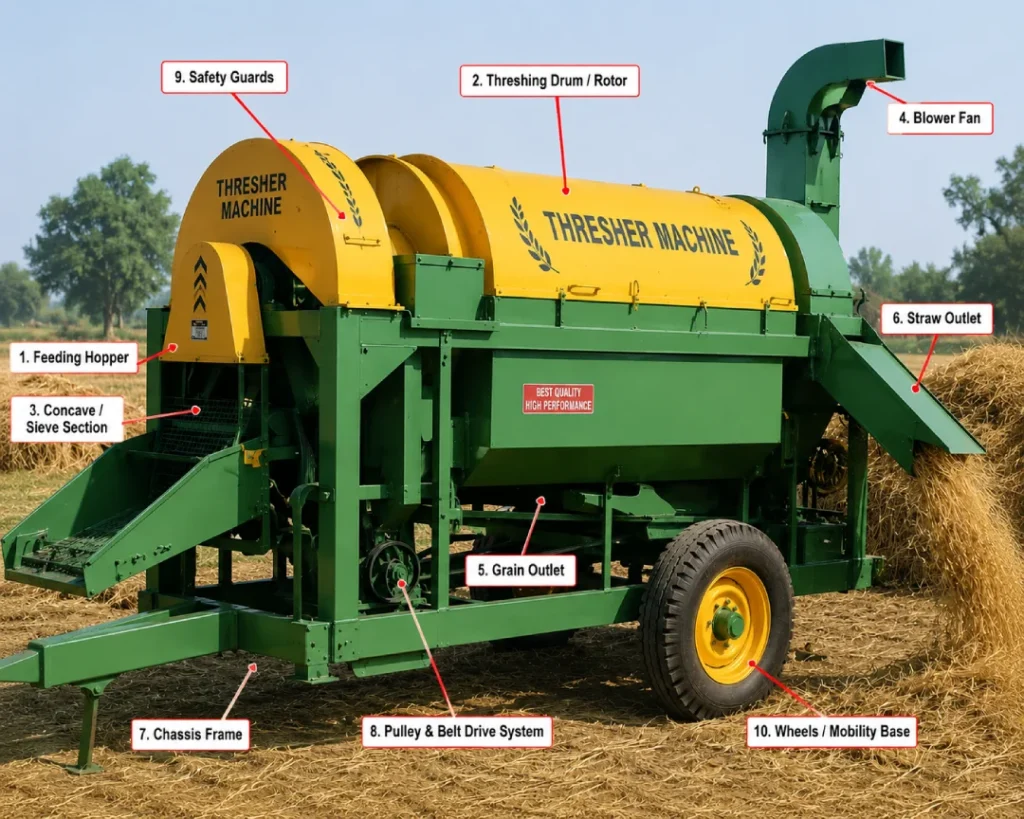
2. Threshing Drum / Rotor
The threshing drum, also known as the rotor, is the core working component of the machine. It consists of a high-speed rotating cylindrical drum fitted with spikes, teeth, rasp bars, or blades. As the crop enters the chamber, the rotating drum strikes and rubs the crop against the concave section, separating grains from stalks and husks. The drum operates at high RPM (Revolutions Per Minute), making precision balancing and strong fabrication extremely important for smooth and vibration-free operation.
3. Concave / Sieve Section
The concave is located beneath the threshing drum and contains perforated metal screens or sieve openings. Its primary function is to allow separated grains to pass through while retaining larger straw particles. The gap between the drum and concave plays a critical role in threshing efficiency and grain quality. Different sieve sizes are used depending on the crop type such as wheat, rice, maize, or millet. Accurate fabrication of the concave ensures effective grain separation with minimal grain damage.
4. Blower Fan
The blower fan is responsible for cleaning the threshed grain by removing lightweight impurities such as dust, chaff, husk, and dry leaves. It generates controlled airflow inside the cleaning chamber, allowing heavier grains to settle while lighter waste particles are blown away. Proper airflow management improves grain cleanliness and reduces manual cleaning requirements after threshing. High-speed blower fans require dynamically balanced components for stable operation and low noise levels.
5. Grain Outlet
The grain outlet is the discharge section where cleaned and separated grains are collected after the threshing and cleaning process. It is designed to provide smooth grain flow into bags, trays, or storage containers without blockage or spillage. In advanced threshers, grain outlets may include collection augers or conveyors for automated grain handling. A properly designed outlet improves harvesting efficiency and reduces grain losses during operation.
6. Straw Outlet
After grain separation, the leftover crop residue such as straw and stalks is discharged through the straw outlet. This section ensures continuous removal of agricultural waste from the machine to prevent internal clogging. Depending on the machine design, the straw may be discharged in chopped or uncut form for further agricultural use such as animal feed, composting, or biomass fuel applications. Strong fabrication is essential because this section handles continuous high-volume material flow.
7. Chassis Frame
The chassis frame forms the structural backbone of the thresher machine. It supports all major components including the drum assembly, motor, blower system, hopper, and outlets. The frame is usually fabricated using heavy-duty steel sections to withstand vibrations, operational stress, and field conditions. Accurate welding, alignment, and structural rigidity are important to maintain machine stability and durability during long working hours.
Modern manufacturers often use Laser welding machine systems for faster structural welding and improved weld consistency in chassis fabrication. For portable repair and field-level fabrication work, Handheld Laser welding machine solutions are also becoming popular due to flexibility and ease of operation.
8. Pulley & Belt Drive System
The pulley and belt drive system transfers power from the engine, electric motor, or tractor PTO (Power Take-Off) to the rotating components of the thresher. Different pulley sizes are used to control drum speed and blower speed according to crop requirements. Belt drives provide smooth power transmission and help absorb shock loads during operation. Proper alignment and tensioning are necessary to minimize energy loss and prevent belt slippage.
9. Safety Guards
Safety guards are protective covers installed around rotating shafts, belts, pulleys, chains, and moving drums. Their purpose is to protect the machine operator from accidental contact with high-speed moving parts. These guards are generally made from fabricated sheet metal or mesh structures that allow ventilation while ensuring operational safety. Safety features are especially important in agricultural machinery because threshers operate in open field environments with continuous human interaction.
10. Wheels / Mobility Base
Threshers are often used in different agricultural fields, making mobility an important feature. Wheels or a mobility base are attached to the chassis for easy transportation of the machine between locations. Depending on the machine size, threshers may use pneumatic tires, solid wheels, or tractor-mounted systems. A stable mobility structure improves machine handling on uneven farm surfaces and enhances operational convenience for farmers.
Laser Cut Components in a Thresher
Modern threshers use many laser-cut components.
Common Laser Cut Parts:
- Sheet Metal Body Panels: Outer covers, access doors, side walls, top panels.
- Feeding Tray Plates: Smoothly cut and folded feed channels.
- Rotor Blade Mounting Plates: Precision cut for exact alignment.
- Perforated Sieves & Screens: Laser cut hole patterns for grain separation.
- Support Brackets: Motor mounts, fan supports, bearing supports.
- ulley Guards: Protective covers with ventilation patterns.
- Frame Plates: Joining plates for welded chassis structure.
- Inspection Covers: Laser cut openings and hinged service panels.
- Branding Panels: Manufacturer logo and name plates.
Many manufacturers also use Laser engraving machine systems for branding plates, serial numbers, machine identification, QR codes, and traceability marking on thresher components.
Manufacturing Process of Thresher Using Laser Cutting
Step 1: CAD Design
Engineers create 2D/3D designs for all thresher components.
Step 2: Nesting Software
Parts are arranged on metal sheets to maximize material usage.
Manufacturers aiming to reduce sheet wastage and improve profitability should also understand Nesting Software and Material Optimization: How Manufacturers Save Up to 20 Percent Cost. Smart nesting plays a major role in reducing raw material expenses in agricultural equipment production.
Step 3: Fiber Laser Cutting
Laser machine cuts:
• Mild steel sheets
• HR sheets
• CR sheets
• Stainless steel parts
Advanced Best Laser Cutting Machine for Sheet Metal systems help manufacturers achieve higher production speed with lower rejection rates.
Step 4: Bending Process
Laser cut flat parts go for CNC bending.
Step 5: Welding Assembly
Frame and body components are welded.
Step 6: Machining
Shafts, drums, pulleys, bearings housings are machined.
Step 7: Painting / Powder Coating
Rust-resistant finish applied.
Step 8: Final Assembly
Motor, belts, bearings, drum, screens fitted.
Step 9: Trial Testing
Machine checked for:
- RPM balance
- Output capacity
- Noise level
- Vibration
- Grain quality
For manufacturers planning to automate agricultural equipment fabrication, SLTL Group offers advanced CNC cutting machine for metal applications with automation-ready solutions for sheet and tube processing.
Benefits of Fiber Laser Cutting for Thresher Parts
- High Accuracy: Exact dimensions improve assembly fitment.
- Faster Production: Cuts multiple parts quickly compared to manual methods.
- Better Edge Quality: Less grinding and finishing required.
- Hole Precision: Perfect holes for bolts, shafts, mounting points.
- Lower Material Waste: Nesting software saves sheet metal cost.
- Repeatability: Every batch remains consistent.
- Complex Design Capability: Vent patterns, slots, curves, branding cuts possible.
Material Used in Thresher Production
Different parts require different materials.
| Part | Material |
|---|---|
| Body Panels | Mild Steel |
| Rotor Blades | High Carbon Steel |
| Shaft | EN8 / Alloy Steel |
| Screens | Wear Resistant Steel |
| Guards | MS Sheet |
| Hopper | GI / MS Sheet |
| Frame | Structural Steel |
| Fasteners | High Tensile Steel |
Laser cutting handles most sheet metal parts efficiently.
Quality Inspection & Testing in Thresher Manufacturing
To ensure reliable performance, durability, and operator safety, thresher manufacturers perform multiple quality inspection and testing procedures during fabrication and final assembly. Since threshers operate under heavy loads, high rotational speeds, dust exposure, and continuous vibration, every component must meet strict dimensional and mechanical standards. Detailed inspection helps reduce breakdowns, improve operational efficiency, and extend machine life in harsh agricultural conditions.
1. Dimensional Checks
- Dimensional inspection is one of the most important quality control processes in thresher manufacturing. All fabricated and laser-cut components are measured to verify their exact dimensions according to engineering drawings and design tolerances. Parts such as side panels, rotor housings, support brackets, frames, and sieve assemblies must fit accurately during assembly.
- Manufacturers use measuring tools such as vernier calipers, micrometers, gauges, height gauges, and coordinate measuring machines (CMMs) to inspect component dimensions. Precise dimensional accuracy ensures proper alignment of rotating parts, smooth assembly, reduced vibration, and minimal mechanical wear during operation. Even small dimensional errors can affect threshing efficiency and machine stability.
2. Hole Position Inspection
- Threshers contain multiple drilled, punched, or laser-cut holes used for mounting bearings, shafts, motors, guards, pulleys, and structural assemblies. Accurate hole positioning is critical because improper alignment can lead to assembly issues, shaft misalignment, excessive vibration, and premature component failure.
- Manufacturers carefully inspect the center distance, hole diameter, spacing, and alignment using templates, gauges, measuring fixtures, and precision inspection tools. Hole position inspection is especially important for rotor mounting plates, bearing housings, and pulley support sections where alignment directly affects machine performance and rotational balance. Properly aligned holes ensure smooth power transmission and reliable operation.
3. Rotor Balancing
- The threshing drum or rotor operates at very high RPM (Revolutions Per Minute), making dynamic balancing extremely important. Even a slight imbalance in the rotor can create excessive vibration, noise, bearing damage, structural stress, and reduced machine life.
- During rotor balancing, manufacturers test the rotating assembly using balancing machines that detect uneven weight distribution. Additional corrections are made by removing or adding balancing weights until smooth rotation is achieved. Properly balanced rotors improve threshing efficiency, reduce operator discomfort, minimize energy consumption, and protect critical components such as bearings and shafts from premature wear. Rotor balancing also helps maintain consistent grain separation performance during long operating hours.
4. Weld Strength Testing
- The chassis frame and structural assemblies of a thresher are continuously exposed to vibration, impact loads, and heavy crop handling. Strong welding quality is essential to maintain machine durability and structural integrity. Manufacturers perform weld inspection and strength testing to identify cracks, weak joints, porosity, incomplete fusion, or welding defects.
- Visual inspection is commonly performed to check weld uniformity and finish quality, while advanced manufacturers may use non-destructive testing methods such as dye penetration testing or ultrasonic inspection for critical joints. Weld strength testing ensures that the machine frame can withstand continuous agricultural operation without structural failure. High-quality welds improve machine stability, safety, and long-term reliability in demanding field conditions.
5. Functional Testing
- Before delivery, manufacturers conduct complete functional testing to verify the operational performance of the thresher machine. This testing often includes live crop threshing trials using actual agricultural material such as wheat, rice, maize, or millet.
- During the trial, manufacturers evaluate feeding performance, threshing efficiency, grain separation quality, blower performance, grain loss percentage, vibration levels, and overall machine stability. Functional testing helps identify any assembly defects, abnormal noise, overheating, or operational issues before the machine reaches the customer. It also ensures that the thresher performs efficiently under real working conditions and meets agricultural productivity requirements.
6. Paint Adhesion Test
- Threshers are frequently exposed to dust, moisture, mud, fertilizers, and changing weather conditions during field operation. To prevent rust and corrosion, manufacturers apply protective paint or powder coating on machine surfaces. Paint adhesion testing is conducted to ensure that the coating bonds properly with the metal surface and provides long-term protection.
- Manufacturers may perform scratch tests, tape tests, thickness checks, or salt spray testing to evaluate coating quality and corrosion resistance. Proper paint adhesion improves machine appearance, increases resistance to environmental damage, and extends equipment life. A high-quality coating also reduces maintenance costs and protects fabricated components from premature corrosion in outdoor agricultural environments.
Productivity Benefits for Manufacturers
By using laser cutting, thresher manufacturers gain:
- Shorter lead times
- Lower manpower dependency
- Faster batch production
- Better machine finish
- Reduced rejection rate
- Easier customization
- Improved profit margins
This is why many OEM agricultural equipment companies now adopt fiber laser cutting systems.
Future of Smart Thresher Manufacturing
The next generation of threshers will include:
- Lightweight laser fabricated designs
- IoT-based maintenance alerts
- Precision rotor balancing systems
- Better grain recovery systems
- Solar / electric powered threshers
- Modular replaceable laser-cut parts
- CNC automated production lines
Laser technology will remain at the center of this transformation.
Conclusion
The thresher industry is moving toward smarter, faster, and more reliable manufacturing, and fiber laser cutting is leading that change. From body panels to sieves, brackets, covers, and structural components, laser cutting improves every stage of thresher production.
Manufacturers who adopt laser technology can produce stronger machines, reduce costs, increase speed, and meet growing agricultural demand with consistent quality.
Modern fabrication companies are now integrating Laser solution systems including laser cutting machine, Laser welding machine, Handheld Laser welding machine, and Laser engraving machine technologies to improve productivity and remain competitive in agricultural equipment manufacturing.
If you are a thresher manufacturer looking to modernize production, investing in advanced fiber laser cutting solutions is the key to future growth.
SLTL Group offers advanced Fiber laser cutting machine systems for agricultural machinery manufacturers looking for precision, speed, automation, and better material utilization. Whether you need a High power laser cutting machine for heavy-duty production or a Lower power laser cutting machine for medium fabrication applications, SLTL provides customized manufacturing solutions for your business growth.
To discuss the right laser technology for your thresher manufacturing plant, contact SLTL Group at +91 9925036495, email mkt@sltl.com, or visit www.sltl.com.
FAQs: Thresher Manufacturing and Laser Cutting Technology
1. How can I reduce production cost while manufacturing thresher machine parts?
You can reduce production cost by using a fiber laser cutting machine with nesting software. It helps you save material, reduce labor dependency, minimize rework, and improve production speed.
2. Which laser cutting machine is best for manufacturing thresher body panels and structural parts?
You should choose the laser cutting machine based on sheet thickness, production volume, and automation needs. High power laser cutting machines are suitable for heavy-duty agricultural equipment manufacturing.
3. Can I manufacture thresher sieves and perforated screens using laser cutting technology?
Yes, you can manufacture highly accurate sieves and perforated screens using laser cutting. It gives you precise hole patterns, smooth edges, and better grain separation performance.
4. How can I improve thresher machine quality and reduce vibration issues?
You can improve machine quality by using precision laser-cut components with accurate hole positions and proper rotor balancing. This helps you reduce vibration, misalignment, and premature bearing failure.
5. Is fiber laser cutting better than plasma cutting for thresher manufacturing?
Yes, fiber laser cutting gives you cleaner edges, higher dimensional accuracy, faster production, and lower finishing work compared to plasma cutting for thresher parts production.
6. Can I use tube laser cutting machines for agricultural machinery manufacturing?
Yes, you can use tube laser cutting machines for manufacturing chassis frames, pipe structures, supports, and light agricultural structures with high accuracy and faster production speed.
7. How can I increase production capacity for my thresher manufacturing business?
You can increase production capacity by automating sheet processing with CNC laser cutting machines, reducing manual fabrication time, and improving batch consistency.
8. Should I invest in a high power laser cutting machine or a lower power laser cutting machine for thresher production?
You should select the machine according to your material thickness and production scale. High power machines are suitable for thick plate cutting and heavy production, while lower power machines work well for medium fabrication requirements.
9. Can laser welding machines improve thresher chassis fabrication quality?
Yes, laser welding machines help you achieve stronger weld quality, lower distortion, faster welding speed, and cleaner finishing for thresher chassis and structural assemblies.
10. Where can I get complete laser solutions for agricultural machinery manufacturing?
You can get complete laser solutions including laser cutting machines, tube laser cutting systems, laser welding machines, handheld laser welding machines, and laser engraving machines from SLTL Group. For consultation, contact +91 9925036495, email mkt@sltl.com, or visit www.sltl.com.
Author Bio

Mayank Patel
R&D HeadMayank Patel is the Head of Research & Development at SLTL Group, bringing over 20+ years of hands-on experience in the field of laser technology. A forward-thinking innovator, he has played a pivotal role in developing advanced laser cutting, welding, and marking solutions tailored for diverse industries. Under his leadership, SLTL’s R&D division continues to push the boundaries of what laser systems can achieve in modern manufacturing.