Rising steel costs, hidden rework, and low machine utilization could be cutting into your profits. Learn how leading PEB manufacturers improve ROI, reduce waste, and boost productivity with smart fabrication and advanced laser technologies before competitors pull ahead.
Introduction
In today’s competitive construction and infrastructure market, profitability depends not only on winning projects but also on how efficiently they are executed. For companies involved in PEB manufacturing, cost control has become a strategic priority. Large-scale Pre-Engineered Building projects demand significant investment in steel, fabrication equipment, manpower, logistics, coatings, and project execution. Even small inefficiencies across these stages can create major financial impact.
At the same time, customers expect faster delivery, consistent quality, and competitive pricing. This has pushed manufacturers to adopt smarter production systems, leaner workflows, and automation-driven fabrication technologies. The goal is clear: optimize operational cost while maximizing return on investment (ROI).
In modern PEB manufacturing, cost optimization is no longer limited to reducing raw material expenses. It now includes process efficiency, energy management, labor productivity, machine utilization, reduced rework, and lifecycle performance. When managed correctly, these factors can significantly improve margins and create long-term business growth.
According to industry estimates, raw materials typically account for 50% to 70% of the total cost of a steel fabrication project. Meanwhile, rework and quality issues can consume 5% to 15% of project budgets if not properly controlled. These numbers clearly show why cost optimization has become a major focus area for modern manufacturers.
Why Cost Optimization Starts with Understanding PEB Fundamentals
Before manufacturers focus on cost reduction strategies, it is important to understand the complete framework of a Pre-Engineered Building project. Companies that are new to the industry can explore What is a Pre-Engineered Building (PEB)? A Complete Guide to better understand how design, fabrication, transportation, and erection activities influence project costs.
Since steel forms the foundation of every PEB structure, understanding material specifications is equally important. Manufacturers can also refer to Understanding Structural Steel Requirements in PEB Systems to gain deeper insight into steel grades, load-bearing requirements, and structural optimization strategies that directly impact project profitability and long-term ROI.
Understanding Cost Structure in PEB Manufacturing
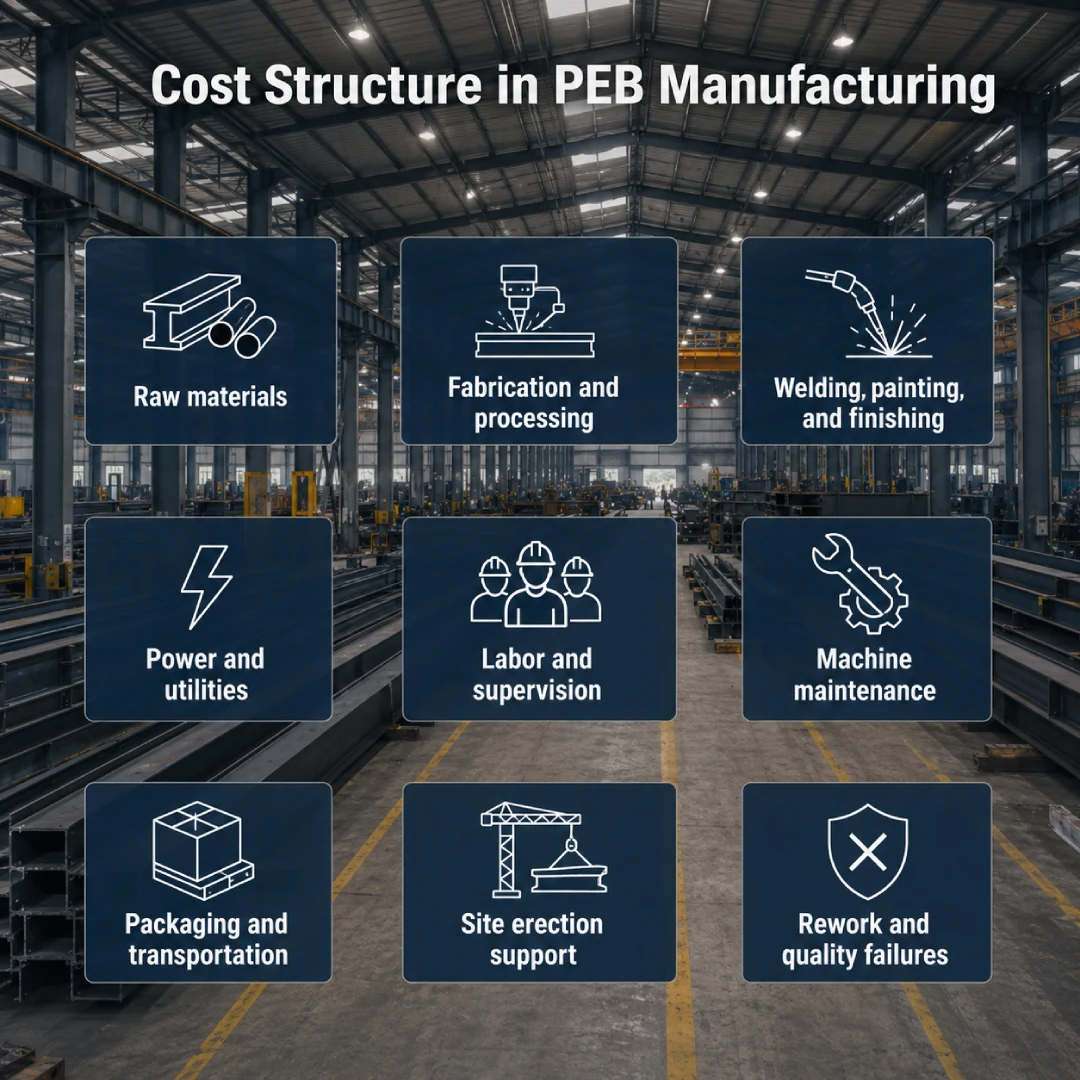
To improve profitability, manufacturers must first understand where costs occur.
Major Cost Components Include:
- Raw materials (steel plates, coils, sheets, fasteners)
- Fabrication and processing
- Welding, painting, and finishing
- Power and utilities
- Labor and supervision
- Machine maintenance
- Packaging and transportation
- Site erection support
- Rework and quality failures
In many cases, raw material and fabrication together represent the largest portion of project cost, making them key targets for optimization. Industry studies indicate that fabrication-related activities alone can account for 20% to 30% of total project costs. Therefore, even a 5% improvement in fabrication efficiency can generate substantial financial returns on large-volume projects.
Why Cost Optimization Matters in Large-Scale Projects
Large projects amplify both efficiency gains and operational losses. A small percentage saving across hundreds or thousands of tons of steel can generate substantial returns.
Key Reasons It Matters:
- Protect profit margins in competitive bids
- Improve pricing flexibility
- Increase production capacity
- Reduce project delays
- Strengthen long-term ROI
In large-volume PEB manufacturing, efficient systems outperform low-price strategies over time.
For example, reducing material waste by just 3% on a 5,000-ton project can save hundreds of tons of steel annually. Similarly, improving machine utilization from 60% to 80% can significantly increase production output without additional capital investment.
1. Raw Material Cost Optimization
Steel is usually the most significant input cost. Smart procurement and usage planning can directly improve profitability.
Best Practices:
- Strategic Procurement: Bulk buying, long-term supplier agreements, and grade standardization reduce volatility.
- Material Optimization: Using advanced nesting software ensures better sheet and plate utilization.
- Remnant Management: Reusable leftover material can be tracked and consumed in future jobs.
- Design Efficiency: Optimized engineering reduces unnecessary steel tonnage while maintaining structural safety.
These methods significantly improve margins in PEB manufacturing.
Material Optimization Creates Immediate Cost Savings
One of the fastest ways to improve profitability in PEB manufacturing is by reducing material waste during fabrication. Advanced nesting software combined with a modern Laser cutting machine helps manufacturers maximize sheet utilization and reduce scrap generation.
Manufacturers looking to improve steel utilization can explore Material Optimization & Nesting Efficiency in PEB Production, which explains how intelligent nesting strategies can help save significant material costs while improving production efficiency. Industry reports suggest that optimized nesting can improve material utilization by 8% to 20% depending on component complexity and production volume.
Modern Laser solution providers now integrate CAD/CAM software directly with CNC cutting systems. As a result, manufacturers can achieve better material planning, faster processing, and improved inventory utilization. For manufacturers evaluating advanced cutting equipment, both Lower power laser cutting machine and High power laser cutting machine configurations can support material optimization goals depending on production volume and material thickness requirements.
For consultation on improving material utilization and cutting efficiency, manufacturers can contact SLTL Group at +91 99250 36495 or email mkt@sltl.com.
2. Productivity Through Faster Fabrication
Production speed has a direct impact on overhead cost. Slower production means longer machine occupancy, more labor hours, and delayed billing cycles.
How to Improve:
- CNC automation
- Fiber laser cutting for faster component processing
- Parallel fabrication lines
- Reduced setup time
- Better job sequencing
When throughput increases, the same infrastructure can generate higher output, improving ROI.
Fiber Laser Technology Drives Higher Productivity
Productivity improvements often begin with faster and more accurate cutting operations. This is why many large-scale fabricators are replacing traditional cutting methods with advanced fiber laser systems.
Manufacturers can learn more through Advantages of Fiber Laser Cutting in PEB Steel Fabrication, which explains how modern fiber laser technology improves cutting speed, edge quality, dimensional accuracy, and overall throughput.
Compared to conventional thermal cutting processes, a modern Laser cutting machine can improve cutting speeds by several times while reducing secondary finishing operations.
A modern Laser cutting machine significantly reduces setup time while delivering consistent results across large production batches. High-volume manufacturers often prefer a High power laser cutting machine because it can process thicker materials faster and improve machine utilization rates.
At the same time, a Lower power laser cutting machine can provide excellent ROI for manufacturers processing thinner sheets and medium-volume production requirements.
3. Reducing Rework and Quality Losses
One of the most hidden cost drains in PEB manufacturing is rework. Incorrect dimensions, hole mismatch, weld defects, or coating issues create delays and additional expense.
Common Rework Costs:
- Extra labor
- Additional steel consumption
- Delivery delays
- Site correction work
- Reputation damage
Solutions:
- Better production controls
- Automated cutting systems
- Welding quality procedures
- Inspection checkpoints
- Digital drawing revision control
Reducing rework often creates faster ROI than chasing cheaper materials. Industry benchmarks show that companies implementing automation and digital quality control systems often reduce rework rates by 30% to 50%.
Combining Multiple Laser Technologies Reduces Operational Costs
Reducing operational costs is not only about cutting steel faster. It also involves improving traceability, weld quality, and production consistency throughout the fabrication process.
Manufacturers can explore How Combining Laser Cutting, Welding and Marking Machine Reduces Operational Costs to understand how integrated fabrication systems reduce errors, improve workflow efficiency, and lower overall production expenses.
For example:
- A Laser cutting machine ensures dimensional accuracy.
- A Laser welding machine improves weld consistency and strength.
- A Handheld Laser welding machine helps perform fast and precise welding for customized fabrication requirements.
- A Laser engraving machine provides permanent part identification and traceability.
Together, these technologies reduce rework, improve quality control, and create stronger ROI across large-scale fabrication operations.
4. Labor Cost Optimization
Labor remains a major operational expense, especially in fabrication-heavy environments.
Ways to Improve Efficiency:
- Multi-skilled workforce training
- Automated handling systems
- CNC-driven machines
- Standardized work procedures
- Better shift planning
The objective is not simply reducing headcount, but increasing output per employee. For scalable PEB manufacturing, productivity-based labor models are more sustainable than manpower-heavy operations.
Studies show that automation can improve labor productivity by 20% to 40% while also reducing operator fatigue and production variability.
5. Energy and Utility Savings
Steel fabrication facilities consume electricity through cutting, welding, compressors, lighting, and material handling systems.
Optimization Measures:
- Energy-efficient machines
- Scheduled maintenance for compressors
- Smart lighting systems
- Peak load management
- Power factor correction
Over time, energy savings can substantially improve operating margins.
Modern fiber laser systems can consume significantly less energy than traditional CO₂ cutting technologies while maintaining higher productivity levels.
6. Machine Utilization and ROI
Capital equipment such as laser machines, welding lines, and CNC systems represent major investments. ROI depends on how effectively these assets are used.
High ROI Comes From:
- Maximum uptime
- Preventive maintenance
- Multi-shift operation
- Balanced production loading
- Skilled operators
An expensive machine with low utilization creates weak returns. A well-managed machine generates long-term profitability. Manufacturers that achieve machine utilization rates above 80% often see substantially faster equipment payback periods compared to facilities operating below 60%.
7. Faster Project Completion = Faster Cash Flow
In large-scale PEB manufacturing, speed improves financial performance beyond fabrication cost.
Benefits of Faster Completion:
- Early billing milestones
- Reduced working capital blockage
- Faster client handover
- Ability to take new projects sooner
This improves cash rotation and annual revenue capacity.
Applications Across Multiple PEB Project Types
Different PEB projects have different fabrication requirements. Warehouses, industrial facilities, logistics centers, manufacturing plants, and commercial buildings all require varying levels of structural complexity.
Manufacturers can gain additional insight from Applications of Fiber Laser Cutting Across PEB Projects (Industrial, Commercial, Warehousing), which explains how fiber laser technology supports diverse fabrication requirements while maintaining cost efficiency.
By using advanced CNC processing systems and automated production workflows, fabricators can accelerate project completion timelines and improve cash flow cycles.
8. Logistics and Packaging Optimization
Transport is a major cost in large PEB projects because steel members are bulky and heavy.
Optimization Methods:
- Better bundling plans
- Standardized transport loads
- Sequenced dispatch by erection priority
- Reduced damage through protective packaging
Efficient dispatch reduces hidden cost and site delays.
Industry data suggests that proper packaging and dispatch planning can reduce transportation-related losses and damage claims by 10% to 25%.
9. Role of Technology in ROI Growth
Modern PEB manufacturing increasingly depends on digital systems that improve decision-making. Useful Technologies:
- ERP for cost tracking
- CAD/CAM integration
- Production dashboards
- Barcode or laser marking systems
- Predictive maintenance tools
These systems help manufacturers monitor real cost per project instead of relying on assumptions.
Digital Traceability and Smart Manufacturing
As PEB projects become larger and more complex, traceability becomes increasingly important. This is where Laser engraving machine technology plays a valuable role.
Laser marking systems can create permanent identification marks, part numbers, batch codes, QR codes, and assembly references directly on fabricated components. This improves inventory management, simplifies erection processes, and reduces the risk of assembly errors.
When integrated with ERP systems and production dashboards, laser marking becomes an important part of smart manufacturing and cost optimization initiatives.
10. Measuring ROI in PEB Manufacturing
ROI should be evaluated not only on machine purchase but across total business impact.
ROI Metrics Include:
- Output increase per month
- Scrap reduction percentage
- Labor saving per ton
- Rework reduction
- Delivery time improvement
- Profit margin growth
- Machine payback period
Strong ROI often comes from multiple smaller improvements rather than one dramatic change.
11. Common Mistakes That Reduce ROI
Many businesses invest in equipment but fail to realize returns due to poor execution.
Common Errors:
- Buying machines without production planning
- Underutilized capacity
- Poor operator training
- No maintenance system
- Weak costing controls
- Excessive manual handling
In PEB manufacturing, discipline is as important as investment.
How Laser Technology Supports Multiple Industries
The same technologies that improve ROI in PEB manufacturing are also helping businesses across multiple industries improve productivity and profitability.
Industries Benefiting from Advanced Laser Technologies:
- Automotive Parts Manufacturing
- Tool and Mold Manufacturing
- Jewellery Manufacturing
- Aerospace Manufacturing
- Electronics Manufacturing
- Medical Devices Manufacturing
- Construction Industry
Many of these industries report double-digit productivity improvements after adopting advanced laser processing systems.
Across these industries, advanced Laser solution platforms, Laser cutting machine systems, Laser welding machine technology, Handheld Laser welding machine solutions, and Laser engraving machine systems help manufacturers reduce operational costs while improving production quality.
Why Choosing the Right Laser Equipment Matters
Selecting the correct laser system directly affects ROI. Manufacturers should evaluate:
- Production volume
- Material thickness
- Energy consumption
- Automation requirements
- Future scalability
For thin-sheet applications, a Lower power laser cutting machine may offer the most practical investment. For heavy-duty structural fabrication and high-volume processing, a High power laser cutting machine can deliver superior throughput and faster payback periods.
A complete manufacturing strategy may also include laser welding and laser marking technologies to further optimize production efficiency.
12. Future Trends in Cost Optimization
The future of cost-efficient PEB production will be driven by:
- AI-based production scheduling
- Automated fabrication lines
- Real-time costing dashboards
- Smart inventory management
- Lower-energy processing systems
- Design-to-manufacture integration
These systems will create faster and more predictable ROI.
Industry analysts predict that smart manufacturing technologies could improve fabrication productivity by 15% to 30% over the coming years while simultaneously reducing operating costs.
Conclusion
Cost optimization and ROI are central to sustainable growth in modern PEB manufacturing. Large-scale operations cannot rely solely on volume, they must rely on efficiency. Every stage, from steel procurement and cutting to labor planning, logistics, and machine utilization, contributes to profitability.
Manufacturers that adopt precision technologies, smart planning systems, and continuous improvement practices gain stronger margins, faster cash flow, and higher long-term returns. In an increasingly competitive market, optimized operations are not just an advantage, they are a necessity.
Organizations looking to improve fabrication efficiency can benefit from modern Laser solution technologies including Laser cutting machine, High power laser cutting machine, Lower power laser cutting machine, Laser welding machine, Handheld Laser welding machine, and Laser engraving machine systems.
For businesses operating in Construction, Automotive Parts Manufacturing, Tool and Mold Manufacturing, Jewellery Manufacturing, Aerospace Manufacturing, Electronics Manufacturing, and Medical Devices Manufacturing, investing in the right technology can create measurable improvements in productivity, quality, and profitability.
Contact SLTL Group +91 99250 36495 or mail at mkt@sltl.com. Also visit www.sltl.com to know more about all the machines.
Connect with our experts to explore advanced laser solutions designed to improve cost efficiency, material utilization, productivity, and ROI across your manufacturing operations.
FAQs
1. How do I know if investing in a laser cutting machine will actually improve my ROI in PEB manufacturing?
You can evaluate ROI by comparing your current material waste, labor costs, production speed, and rework expenses with the expected improvements from a laser cutting machine. If you handle large fabrication volumes, you can often achieve faster production, lower scrap, and better profitability.
2. Which is better for my PEB fabrication business, a high power laser cutting machine or a lower power laser cutting machine?
You should choose based on the material thickness and production volume you handle. A lower power laser cutting machine works well for thinner sheets and moderate workloads, while a high power laser cutting machine is better for heavy structural steel and high-volume production.
3. Can I reduce material waste in my PEB plant without increasing production costs?
Yes. You can reduce waste by using nesting software, optimizing cutting layouts, and integrating advanced laser solutions. Better material utilization often lowers costs without requiring major operational changes.
4. How quickly can I recover my investment after installing a laser cutting machine?
Your payback period depends on production volume, machine utilization, and current operating costs. Many manufacturers see returns through reduced scrap, lower labor requirements, faster processing, and decreased rework.
5. Should I invest in a laser welding machine along with a laser cutting machine?
If your fabrication process includes significant welding work, you can benefit from combining both technologies. A laser welding machine helps improve weld quality, reduce distortion, and increase productivity across large-scale projects.
6. How can a handheld laser welding machine help my fabrication team?
You can use a handheld laser welding machine for flexible welding applications, repair work, customized fabrication, and complex joints. It often helps reduce welding time while improving consistency and appearance.
7. Do I really need a laser engraving machine in my PEB manufacturing operation?
If you want better traceability, inventory management, and component identification, a laser engraving machine can provide long-term value. You can permanently mark part numbers, QR codes, and assembly information directly on components.
8. How can I reduce rework costs in my PEB fabrication facility?
You can reduce rework by improving cutting accuracy, implementing quality checkpoints, using automated fabrication equipment, and maintaining proper drawing control. Precision laser technologies help eliminate many common fabrication errors.
9. What should I consider before selecting a laser solution for my business?
You should evaluate your production volume, material thickness range, automation requirements, future growth plans, and operating costs. Choosing the right laser solution ensures better productivity and a stronger return on investment.
10. How can I get expert guidance for improving ROI in my PEB manufacturing operations?
You can consult experienced laser technology providers at +91 99250 36495 who understand PEB fabrication requirements. SLTL Group can help you evaluate the right laser cutting, welding, and marking solutions based on your production goals.
Author Bio

Mayank Patel
R&D HeadMayank Patel is the Head of Research & Development at SLTL Group, bringing over 20+ years of hands-on experience in the field of laser technology. A forward-thinking innovator, he has played a pivotal role in developing advanced laser cutting, welding, and marking solutions tailored for diverse industries. Under his leadership, SLTL’s R&D division continues to push the boundaries of what laser systems can achieve in modern manufacturing.