Purlins shape roof strength in every PEB project. Learn how laser cutting improves accuracy, speed, fit-up, and cost control before competitors deliver faster, cleaner steel buildings. Upgrade your fabrication now, or risk costly production delays!
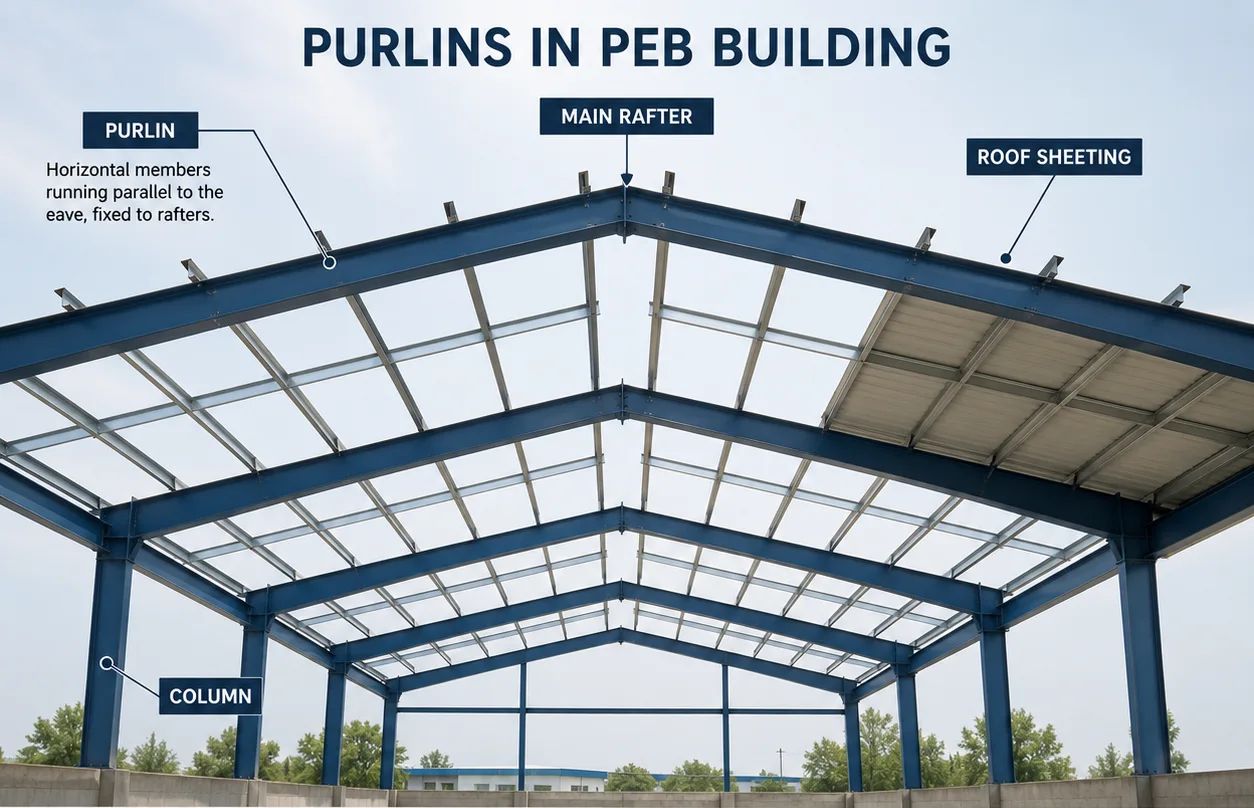
A purlin is a horizontal structural steel member used in roofing systems of Pre-Engineered Buildings (PEBs). It is installed parallel to the building eave and supported by rafters, trusses, or primary frame members. Its primary role is to support roof sheeting/cladding and transfer roof loads to the main structural framework.
In PEB structures, purlins act as secondary structural members, improving load distribution, structural stability, and roofing support efficiency.
If you are new to PEB structures, you can also read What is a Pre-Engineered Building (PEB)? A Complete Guide. It will help you understand how primary members, secondary members, roofing systems, and connection parts work together in a complete steel building.
Role of Purlins in Pre-Engineered Buildings
1. Roof Load Transfer
Purlins transfer loads such as:
- Dead load (roof sheet/self-weight)
- Live load
- Wind load
- Rain/snow load
These loads move from roofing sheets → purlins → rafters → columns → foundation.
Because of this, purlin accuracy matters a lot. Even a small mismatch in hole position, slot size, or end cut can affect roof alignment during site assembly. Therefore, many PEB manufacturers now use a CNC Laser Cutting Machine for more consistent purlin processing.
2. Structural Stability
They reduce unsupported span between rafters and prevent roof sagging.
In large industrial sheds, warehouses, and logistics buildings, purlins also help maintain roof shape under wind pressure. Therefore, accurate fabrication is important from the start.
3. Support for Roof Cladding
They create a continuous support line for:
- Metal roof sheets
- Sandwich panels
- Insulated panels
- Solar roof mounting systems
When roof cladding is installed, the purlin line must remain straight and properly aligned. So, consistent cutting and hole piercing are important during fabrication.
4. Weight Optimization
Cold-formed steel purlins reduce structural weight compared to heavier rolled members.
This helps PEB manufacturers reduce steel usage while still meeting design requirements. For more details on this topic, you can read Understanding Structural Steel Requirements in PEB Systems. It explains how steel selection, member design, and load requirements affect PEB performance.
5. Faster PEB Installation
Pre-fabricated purlins simplify site assembly and bolted installation.
Since most PEB projects work on strict timelines, ready-to-install purlins can reduce site delays. Also, when bolt holes and slots are cut with high accuracy, workers can assemble parts faster with fewer corrections.
Types of Purlins Used in PEB
1. C Purlins
C-shaped steel sections mainly used for:
- Wall support
- Floor framing
- Side rails
- Shorter spans
- Simple-span structures
Features:
- High dimensional stability
- Easy fabrication
- Good load resistance
C purlins are useful in areas where straightforward support is needed. They are also easier to handle during fabrication and installation.
2. Z Purlins
Z-shaped sections are common in industrial PEB roofing.
Used for:
- Roof systems
- Long-span industrial sheds
- Warehouses
- Multi-span overlap connections
Advantages:
- Higher flexural strength
- Better overlapping capability
- Efficient long-span load handling
- Everest notes C and Z purlins as common PEB section types.
Z purlins are often preferred in large PEB roofing systems because they can overlap easily. As a result, they help improve strength across longer roof spans.
Materials Used for Purlin Manufacturing
Typically:
| Material | Use |
|---|---|
| Galvanized Steel | Corrosion resistance |
| Mild Steel | Standard industrial use |
| Cold-Formed Steel | Most common PEB purlins |
| High Tensile Steel | Heavy load-bearing structures |
Cold-formed steel is commonly used due to strength-to-weight efficiency.
Material choice depends on span length, roof load, wind zone, corrosion risk, and project type. Therefore, the cutting process must match the selected material. A lower power laser cutting machine may be suitable for lighter gauges. However, a high power laser cutting machine may be preferred when thicker or stronger sections are processed.
In many PEB plants, the right laser solution helps improve material use, reduce rework, and maintain consistency across large production batches.
For deeper insight, you can also read Material Optimization & Nesting Efficiency in PEB Production. It explains how better nesting helps manufacturers save material and reduce waste during steel fabrication.
Can Purlins Be Cut Using Laser Cutting Machines?
Yes, purlins can be manufactured and precision-processed using fiber laser cutting and tube/profile laser cutting systems, especially in modern PEB plants.
Laser cutting is mainly used for precision processing, hole making, slotting, notching, chamfering, end trimming, and profile preparation.
A Fiber laser cutting machine, Laser cutter, CNC cutting machine, or cutting machine for metal can help manufacturers produce purlins with better dimensional control. Also, laser cutting reduces manual marking and drilling dependency in many operations.
For PEB manufacturers handling repeated parts, the Best Laser Cutting Machine for Sheet Metal can improve speed and accuracy in related sheet and plate components. Meanwhile, tube and profile cutting systems help with purlins, braces, and secondary structural parts.
How Purlins Are Manufactured with Laser Cutting Machines
Step 1: Raw Material Selection
Steel coil / galvanized steel / HR strip selected as per:
- Thickness
- Span requirement
- Wind load
- Roof design
- Structural calculations
At this stage, manufacturers must select the right material grade and thickness. This ensures the final purlin can carry the required load.
Step 2: Roll Forming / Profile Forming
Steel strip is roll-formed into:
- C Purlins
- Z Purlins
- Sigma sections
- This forms the cross-section.
Roll forming gives the purlin its shape. After that, laser cutting can be used for accurate end cuts, holes, slots, and notches.
Step 3: Fiber Laser Cutting / Profile Cutting
After forming, fiber laser cutting machines process purlins.
Laser Operations:
a) End Cutting / Length Cutting
Laser precisely cuts purlins to required span length.
Used for:
- Roof purlins
- Wall girts
- Side rails
Accurate length cutting helps parts fit correctly during site installation. Also, it reduces the need for manual trimming at the project site.
b) Hole Piercing
Bolt holes for mounting are laser cut with high precision.
Applications:
- Connection bolts
- Roof fixing points
- Structural joining
When holes are accurate, assembly becomes faster. Also, the risk of misalignment is reduced.
c) Slot Cutting
Laser creates slots for:
- Overlap joints
- Adjustable mounting
- Roof system alignment
Slot cutting is important in Z purlins, especially where overlap joints are used. With laser cutting, slot size and position can be repeated across multiple parts.
d) Notching
Required for assembly intersections.
Useful for:
- Overlap seating
- Frame connection
- Structural clearance
Notching helps purlins fit around other structural members. Since these cuts need accuracy, laser processing is a strong option.
e) Chamfer Cutting
Edge preparation before fitting/welding.
Chamfer cutting helps improve fit-up quality. It also supports better joint preparation in selected fabrication processes.
f) Web & Flange Trimming
Laser trims:
- Uneven edges
- Extra flange sections
- End geometries
Web and flange trimming are useful when custom end shapes are required. This is common in special PEB designs and complex roof structures.
Tube Laser Cutting for Purlin Processing
If purlins are made from structural hollow sections or tubular secondary supports, tube laser cutting is useful for:
- Tube notching
- Fish-mouth cuts
- Angle cuts
- End cuts
- Slotting
- Hole drilling
- Structural brace connections
This is useful in hybrid PEB systems.
Tube laser cutting can also support secondary frame members, bracing parts, and support structures. So, manufacturers working on mixed steel profiles can benefit from both flatbed and tube cutting systems.
Why Fiber Laser Cutting is Ideal for Purlins
1. High Accuracy
Tight tolerance for bolted roof assembly.
Accuracy is important because purlins are repeated across the roof structure. If one batch has hole mismatch, the issue can affect many parts.
2. Burr-Free Edge Quality
Less secondary finishing.
Clean edges reduce grinding time. Also, they help improve handling safety during assembly.
3. Faster Production
High-speed repetitive cutting for mass PEB production.
A fiber laser cutting machine can process repeated patterns quickly. Therefore, it is useful for manufacturers handling high-volume PEB orders.
4. Low Heat Affected Zone (HAZ)
Protects dimensional stability.
Low heat impact helps maintain purlin shape. This is useful when working with thinner cold-formed sections.
5. Minimal Material Waste
Better nesting and optimized steel utilization.
Material saving is important in PEB production because steel cost affects project profitability. With proper nesting and CNC programming, waste can be reduced.
To understand this in more detail, you can read Material Optimization & Nesting Efficiency in PEB Production. It explains how nesting software helps improve steel utilization in modern fabrication.
6. High Repeatability
Critical for standardized PEB sections.
Repeatability helps manufacturers produce the same hole pattern, slot pattern, and cut length across many purlins. This is especially important in large warehouses, factories, and commercial steel structures.
For more information on the fabrication benefits, you can also read Advantages of Fiber Laser Cutting in PEB Steel Fabrication. It covers how laser cutting improves speed, quality, and repeatability across PEB components.
Looking for Advanced PEB Fabrication Solutions?
If you are planning to upgrade your PEB manufacturing facility with a laser cutting machine, tube laser cutting system, laser welding machine, or complete laser solution, SLTL Group offers advanced technologies for modern steel fabrication.
Whether you need a lower power laser cutting machine for standard sections or a high power laser cutting machine for demanding production, the right system can help improve cutting quality and production speed.
SLTL also supports manufacturers with solutions such as laser engraving machine, laser welding machine, and Handheld Laser welding machine for different fabrication needs.
To discuss your PEB fabrication requirements, you can contact SLTL Group for expert guidance and advanced laser solutions. Reach out by phone at +91 99250 36495, email at mkt@sltl.com, or visit their website at www.sltl.com for more information.
Laser-Cuttable Features on Purlins
| Laser Process | Application in Purlins |
|---|---|
| End Cutting | Length sizing |
| Hole Piercing | Bolt holes |
| Slot Cutting | Adjustable joints |
| Notching | Overlap & seating |
| Chamfering | Fit-up preparation |
| Flange Trimming | Section optimization |
| Profile Cutting | Custom purlin geometry |
These features help manufacturers prepare purlins for faster and cleaner assembly. Also, laser processing supports better control over repeated production batches.
Purlin Manufacturing Workflow
Raw Steel Coil
↓
Roll Forming
↓
C / Z Profile Formation
↓
Fiber Laser Cutting
↓
Hole Piercing
↓
Slot / Notch Cutting
↓
Dimensional Inspection
↓
Galvanizing / Surface Coating
↓
Packing & Dispatch
↓
PEB Site Installation
This workflow helps manufacturers move from raw steel to ready-to-install purlins. Also, when laser cutting, welding, and marking are connected properly, production becomes more controlled.
For this reason, you can also read How Combining Laser Cutting, Welding and Marking Machine Reduces Operational Costs. It explains how integrated machines can reduce manual work, improve traceability, and lower production delays.
Role of Laser Welding and Laser Marking in PEB Fabrication
Purlin production mainly depends on forming and cutting. However, a complete PEB fabrication line may also need welding and marking.
A laser welding machine can support strong and clean welds in selected steel assemblies. A Handheld Laser welding machine can also help manufacturers handle repair, fit-up, and flexible joining needs in fabrication areas.
Similarly, a laser engraving machine (or laser marking system) can be used for part identification. This helps teams mark batch numbers, part codes, assembly references, and quality data.
As a result, manufacturers can improve traceability from production to site installation. This is useful in large PEB projects where hundreds or thousands of steel parts must be tracked correctly.
How Laser Technology Helps Reduce PEB Manufacturing Cost
Purlin manufacturing is not only about cutting speed. It is also about reducing errors, saving material, and improving installation flow. With a Fiber laser cutting machine, manufacturers can reduce manual drilling, punching errors, and rework. Also, cleaner cuts reduce finishing effort. In large-scale PEB production, these small savings can become significant. Better nesting, accurate cutting, faster assembly, and lower rejection can improve overall ROI.
For more clarity, you can read Cost Optimization & ROI in Large-Scale PEB Manufacturing. It explains how manufacturers can control cost across raw material, machines, manpower, and project execution.
Where Purlins Are Used in PEB
- Warehouses
- Industrial sheds
- Logistics parks
- Aircraft hangars
- Cold storage buildings
- Solar support roofing
- Factories
- Agro buildings
- Commercial steel structures
Purlins are also important in construction projects where roof support, structural stability, and fast installation are required. In such projects, accurate cutting and repeatable hole patterns can directly affect assembly speed.
Industries Benefiting from Laser-Cut Structural Components
While purlins are mainly used in PEB and construction, the same laser technology is also used in many other industries.
Modern manufacturers use laser cutting machine systems, laser engraving machine systems, laser welding machine systems, and complete laser solution setups to improve quality and production control.
These industries include:
- Automotive parts
- Tool and Mold Manufacturing
- Jewelery
- Aerospace
- Electronic
- Medical devices
- Construction
In automotive parts manufacturing, laser cutting helps produce accurate brackets, panels, frames, and structural parts. In Tool and Mold Manufacturing, laser systems support accurate cutting and engraving. In Jewelery, laser engraving machine systems are used for fine marking and design work.
Similarly, Aerospace and Medical devices manufacturing need high accuracy and repeatability. Electronic manufacturing also uses laser technology for clean processing and traceability. Construction and PEB fabrication benefit from metal laser cutting, welding, marking, and automation.
So, whether you need a Cutting machine for metal, Best laser cutting machine, laser welding machine, or complete CNC cutting machine setup, laser technology can support many modern production needs.
Why PEB Manufacturers Should Plan Laser Integration Early
PEB manufacturers often face pressure to deliver projects faster while keeping costs under control. However, delays usually happen when cutting, drilling, marking, and assembly are not planned together.
Therefore, laser integration should be planned early. When a manufacturer selects the right laser cutting machine, tube cutting machine, laser welding machine, and laser marking system, the full workflow becomes smoother.
Also, the right system can support future production growth. For example, a lower power laser cutting machine may suit basic purlin or thin sheet processing. However, a high power laser cutting machine may be better for larger production loads and thicker metal parts.
As demand increases, the Best Laser Cutting Machine for Sheet Metal or CNC Laser Cutting Machine can help manufacturers handle more orders with better control.
Why Choose SLTL Group for PEB Laser Solutions?
SLTL Group offers advanced laser solutions for metal fabrication, PEB manufacturing, structural steel processing, and industrial production.
For PEB manufacturers, SLTL can support different needs such as:
- Fiber laser cutting machine
- Tube laser cutting systems
- CNC cutting machine
- Metal laser cutting systems
- Laser welding machine
- Handheld Laser welding machine
- Laser engraving machine
- Laser marking systems
- Custom laser solution for production lines
With the right technology, you can improve purlin accuracy, reduce rework, improve material usage, and speed up project delivery.
Contact SLTL Group today to discuss your laser cutting, welding, marking, or PEB fabrication requirements. You can reach the team by phone at +91 99250 36495, email at mkt@sltl.com, or visit the website at www.sltl.com for more information about available laser solutions and services.
Conclusion
Purlins are among the most important secondary structural members in PEB manufacturing, responsible for supporting roofing systems, transferring loads, and improving structural stability. Based on standard PEB design practice, C and Z purlins are widely used due to strength, flexibility, and lightweight construction.
With fiber laser cutting machines and tube laser cutting systems, purlin production becomes faster, highly accurate, burr-free, and ideal for automated large-scale PEB fabrication. This makes laser technology a major advantage in modern steel building manufacturing.
As PEB projects continue to demand faster production, better accuracy, and improved material utilization, the role of laser cutting becomes even more important. A modern laser cutting machine, Fiber laser cutting machine, or CNC Laser Cutting Machine can help manufacturers produce purlins with consistent quality and faster turnaround.
Also, when laser cutting is combined with laser welding machine, Handheld Laser welding machine, and laser engraving machine systems, manufacturers can build a more connected and efficient production workflow.
If you are planning to upgrade your PEB fabrication setup, SLTL Group can help you choose the right laser solution for your production needs.
Contact SLTL Group today to discuss your laser cutting, welding, marking, or PEB fabrication requirements. You can reach the team by phone at +91 99250 36495, email at mkt@sltl.com, or visit the website at www.sltl.com for more information about available laser solutions and services.
FAQs
1. How do I know if I need a laser cutting machine for purlin manufacturing?
You should consider a laser cutting machine if you are facing slow drilling, hole mismatch, manual rework, rough edges, or delayed PEB assembly. It helps you cut holes, slots, notches, and end profiles with better accuracy and repeatability.
2. Can I use fiber laser cutting for both C purlins and Z purlins?
Yes, you can use a fiber laser cutting machine for both C purlins and Z purlins. It helps you process bolt holes, slots, notches, end cuts, and custom profiles with consistent quality.
3. Which laser cutting machine should I choose for my PEB fabrication plant?
You should choose based on your material thickness, production volume, part size, automation needs, and future expansion plans. For regular purlin and sheet processing, a standard fiber laser cutting machine may work well. For heavy-duty structural work, a high power laser cutting machine may be a better fit.
4. Can I reduce purlin production cost with laser cutting?
Yes, you can reduce cost through faster processing, lower rework, better material use, cleaner edges, and fewer manual operations. Over time, these savings can improve your ROI in large-scale PEB manufacturing.
5. Will laser-cut purlins improve site installation speed?
Yes, they can help improve site installation speed. When holes, slots, and end cuts are accurate, your team can align and bolt purlins faster. This reduces site correction work and helps avoid project delays.
6. Do I need a tube laser cutting machine along with a flatbed laser cutting machine?
You may need both if your PEB work includes tubular supports, braces, hollow sections, and sheet or plate components. A flatbed laser cutting machine handles sheet metal parts, while a tube laser cutting machine supports tubes, pipes, and profile-based structures.
7. Can laser cutting replace drilling and punching in purlin manufacturing?
In many cases, yes. Laser cutting can create accurate holes, slots, and notches without separate drilling or punching steps. However, the final decision depends on your production design, material type, thickness, and workflow.
8. Should I also invest in a laser welding machine for PEB fabrication?
Yes, you should consider it if your plant handles welded assemblies, brackets, frames, or structural parts. A laser welding machine or Handheld Laser welding machine can help you improve weld quality, reduce finishing work, and speed up fabrication.
9. Can I mark purlins and PEB parts for tracking?
Yes, you can use a laser engraving machine or laser marking system to mark part numbers, batch codes, assembly references, and project details. This helps you track parts from production to dispatch and site installation.
10. Why should I choose SLTL Group for my PEB laser solution?
You should choose SLTL Group if you want a complete laser solution for cutting, welding, marking, and automation. SLTL can help you select the right laser cutting machine, tube cutting system, laser welding machine, or laser engraving machine based on your production needs.
Author Bio

Mayank Patel
R&D HeadMayank Patel is the Head of Research & Development at SLTL Group, bringing over 20+ years of hands-on experience in the field of laser technology. A forward-thinking innovator, he has played a pivotal role in developing advanced laser cutting, welding, and marking solutions tailored for diverse industries. Under his leadership, SLTL’s R&D division continues to push the boundaries of what laser systems can achieve in modern manufacturing.