Many manufacturers lose profit due to slow production and high operating costs. See how smart laser automation helps factories cut faster, reduce waste, and achieve ROI much sooner than expected.
Manufacturers today face constant pressure to produce faster, reduce costs, and maintain high product quality. However, traditional manufacturing setups often slow down production and increase operational expenses. Manual handling, inconsistent cutting quality, and excessive material waste can directly affect profitability.
This is where advanced automation makes a real difference. Sahajanand Laser Technology Limited (SLTL Group) is helping manufacturers improve productivity and achieve faster return on investment through smart laser automation solutions. By combining intelligent software, advanced fiber laser technology, and automated production systems, SLTL enables businesses to operate more efficiently and reduce production costs.
Instead of relying on multiple separate processes, manufacturers can now integrate cutting, welding, marking, and engraving operations through a unified laser-based production workflow.
Smart Laser Automation Drives Faster ROI
Many manufacturers struggle with issues like high material wastage, labor dependency, machine downtime, and inconsistent production quality. These challenges directly slow down ROI. SLTL’s smart laser automation solutions address these problems through intelligent system design. Modern laser cutting machine setups from SLTL focus on improving production speed while maintaining accuracy. These systems help manufacturers achieve:
- Reduced production cycle time
- Lower operational costs
- Minimal material wastage
- Higher precision and repeatability
- Reduced manual intervention
By using advanced fiber laser cutting machine technology and CNC controlled systems, manufacturers can increase throughput without affecting product quality, read our blog to know how you can optimize your manufacturing process through software. As production becomes faster and more efficient, businesses recover their machine investment sooner.
Automation Improves Production Efficiency
Automation plays a major role in modern metal fabrication. SLTL integrates automated loading and unloading systems with CNC laser cutting machine technology to streamline production workflows. These automation systems reduce human errors and ensure continuous machine operation. When production interruptions decrease, overall productivity improves significantly.
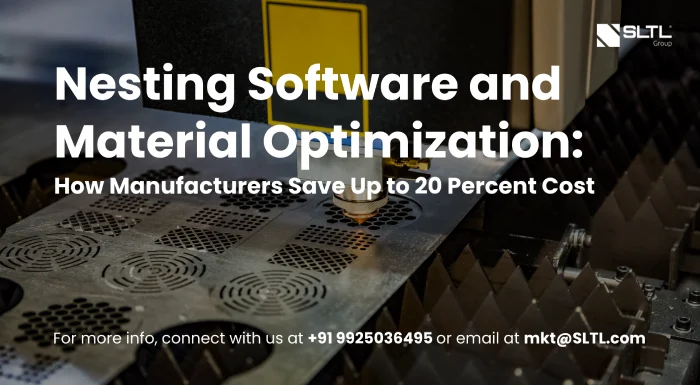
Another important factor is material optimization. Smart nesting software arranges parts on the metal sheet efficiently, which helps maximize sheet usage and reduce scrap material. For industries such as automotive manufacturing, electrical cabinets, kitchen equipment, and heavy engineering, efficient material usage directly impacts production cost. Real time monitoring systems also provide valuable insights into machine performance. Manufacturers can track machine productivity, power consumption, and processing efficiency through integrated monitoring dashboards. This visibility helps production teams quickly identify issues and maintain smooth operations.
Precision That Reduces Secondary Processes
In many traditional cutting methods, secondary finishing operations are required. Grinding, deburring, and polishing increase labor costs and extend production time. However, high precision laser cutter technology significantly reduces these additional steps.
SLTL fiber laser cutting machine systems produce clean edges, narrow kerf widths, and smooth surface finishes. As a result, manufacturers experience several advantages:
- Faster assembly processes
- Improved welding and coating adhesion
- Reduced finishing work
- Lower labor dependency
By minimizing secondary processes, manufacturers can accelerate production timelines and improve overall factory efficiency.
Energy Efficiency Helps Control Costs
Energy consumption is another major concern for manufacturing facilities. Conventional cutting technologies such as plasma or CO₂ systems often consume high power. Fiber laser cutting machines are designed to operate with much higher electrical efficiency. Lower energy consumption helps reduce electricity costs across the production cycle. Fiber laser sources also require fewer consumables and offer longer operational life. Because of this, maintenance requirements remain low compared to traditional systems.
Reduced downtime and fewer replacement parts contribute to stable production performance. Over time, these factors significantly improve ROI for manufacturers.
Flexible Solutions for Multiple Industries
One of the biggest advantages of laser cutting technology is its versatility. SLTL offers laser cutting machine solutions that support various manufacturing industries. For example:
- Automotive manufacturers use CNC laser cutting machine systems for high speed sheet metal cutting.
- Aerospace manufacturers rely on laser cutter precision for critical components.
- Appliance and kitchen equipment industries benefit from smooth edge finishing.
- Electrical enclosure manufacturers achieve accurate panel cutting and engraving.
These flexible capabilities allow manufacturers to scale production without investing in multiple specialized machines.
Building an Integrated Manufacturing Ecosystem
SLTL focuses on delivering complete manufacturing solutions rather than just supplying equipment. The company provides an integrated support ecosystem that helps manufacturers adopt laser automation smoothly. This ecosystem includes:
- Application engineering support
- Customized automation integration
- Operator training programs
- Preventive maintenance services
- Dedicated after sales technical assistance
With proper training and technical support, manufacturers can start achieving production efficiency improvements quickly.
Industry 4.0 and Smart Factory Integration
Modern manufacturing is moving toward digital production environments. SLTL’s laser cutting machine systems are designed to support Industry 4.0 integration. Machines can be connected to centralized monitoring systems that track production performance. Production managers gain access to real time machine data, output statistics, and operational analytics. Predictive maintenance systems can also identify potential issues before they cause machine breakdowns. This approach improves equipment reliability and helps avoid unexpected production stoppages.
Data driven manufacturing enables better planning, improved efficiency, and stronger financial forecasting.
Real Results for Manufacturers
Manufacturers using SLTL’s smart laser automation solutions have reported noticeable improvements in productivity and cost control. Some common performance outcomes include:
- Up to 30 to 50 percent reduction in processing time
- Lower scrap material generation
- Improved overall equipment effectiveness (OEE)
- Faster delivery timelines
- Reduced operational expenses
These improvements show how investing in the best laser cutting machine technology can transform manufacturing operations and generate measurable financial benefits.
Continuous Innovation in Laser Technology
SLTL Group continuously invests in research and development to improve laser technology performance. New developments focus on:
- Better beam quality
- Faster motion control systems
- Improved automation compatibility
- AI driven process optimization
These innovations help manufacturers maintain competitiveness in rapidly evolving industrial markets.
Supporting Sustainable Manufacturing
Sustainability is becoming an important priority across global manufacturing industries. Laser cutting technology helps support environmentally responsible production. Precise laser cutting reduces material waste.
Energy efficient fiber laser sources also lower overall power consumption. Because fewer consumables are required, maintenance waste is also minimized. These factors help manufacturers reduce their environmental impact while maintaining production profitability.
Strengthening Manufacturing Competitiveness
In today’s competitive markets, speed, accuracy, and efficiency determine business success. Manufacturers that adopt automated laser systems gain a strong advantage. Faster production cycles help businesses handle higher order volumes. Consistent product quality improves customer satisfaction and reduces product rejection rates. By integrating smart laser automation into production processes, manufacturers can strengthen their operational performance and achieve sustainable long term growth.
Contact SLTL for Advanced Laser Solutions
If you are looking to improve productivity, reduce operational costs, and achieve faster ROI in manufacturing, SLTL Group offers advanced laser cutting machine solutions designed for modern industries.
To learn more about SLTL’s fiber laser cutting machine, CNC cutting machine, laser welding machine, and laser marking systems, you can contact the SLTL team anytime. For more information, visit www.sltl.com, email mkt@sltl.com, or call +91 9925036495 to speak with a laser technology expert.
FAQs: Smart Laser Automation and Faster ROI
1. I am already using a laser cutting machine. How do I know if my current setup is slowing down my ROI?
If your production still depends heavily on manual handling, frequent downtime, or excessive scrap material, your ROI may be slower than expected. You should evaluate production speed, material utilization, and machine uptime. Upgrading to smarter automation systems can help you improve throughput and recover your investment faster.
2. I already own a fiber laser cutting machine. Why should I consider automation now?
Even if you already have a fiber laser system, automation can significantly improve productivity. Automated loading, unloading, and smart nesting reduce manual work and improve consistency. This allows you to produce more parts in less time and increase overall machine utilization.
3. My laser cutting machine works fine. How can smart automation still improve my production?
Your machine may be working well, but automation helps you remove hidden inefficiencies. Smart nesting software reduces material waste, automated motion systems improve cutting consistency, and monitoring tools help you detect production bottlenecks quickly.
4. I often face material wastage during sheet cutting. Can laser automation really reduce scrap?
Yes, you can significantly reduce scrap with intelligent nesting software. Advanced nesting algorithms place parts more efficiently on the sheet, which increases material utilization and reduces unused scrap areas.
5. I struggle with labor dependency in my workshop. Can laser automation reduce this problem?
You can reduce labor dependency by integrating automated loading systems and CNC-controlled cutting operations. Automation allows your machine to run longer with minimal manual intervention while maintaining consistent quality.
6. I notice that secondary operations like grinding and deburring take a lot of time. Can advanced laser systems help reduce these processes?
You can reduce many secondary finishing operations with high precision laser cutting. Clean edges, narrow kerf width, and smooth finishes often eliminate the need for grinding or heavy deburring.
7. My electricity costs are increasing. Will upgrading to fiber laser systems help control energy consumption?
You can reduce energy consumption with modern fiber laser systems. Fiber lasers are much more energy efficient compared to traditional cutting technologies like plasma or CO2 systems, which helps lower operating costs.
8. I want to increase production but I do not want to expand my factory space. What can I do?
You can increase production capacity by improving machine efficiency instead of expanding space. Smart automation allows your machines to operate faster and longer, which increases output without requiring additional floor space.
9. I am worried about machine downtime. Can smart monitoring systems really help?
You can reduce unexpected downtime with real time monitoring and predictive maintenance. Smart systems track machine performance and alert you early if any component requires attention.
10. I want to improve my delivery timelines for customers. Can laser automation help me achieve this?
You can shorten production cycles with automated laser cutting and welding systems. Faster processing speeds and reduced manual steps allow you to complete orders more quickly.
11. I am planning to upgrade my current laser cutting setup. What should I look for before investing in a new system?
You should look for systems that combine high power fiber lasers, automation compatibility, smart nesting software, and real time monitoring features. These capabilities help ensure that your new system improves productivity and delivers faster ROI.
12. I want to make my factory ready for Industry 4.0. How can laser automation support that goal?
You can connect modern laser machines to centralized monitoring systems that track production data and machine performance. This allows you to manage your production more efficiently and move toward a smart factory environment.
Author Bio

Mayank Patel
R&D HeadMayank Patel is the Head of Research & Development at SLTL Group, bringing over 20+ years of hands-on experience in the field of laser technology. A forward-thinking innovator, he has played a pivotal role in developing advanced laser cutting, welding, and marking solutions tailored for diverse industries. Under his leadership, SLTL’s R&D division continues to push the boundaries of what laser systems can achieve in modern manufacturing.