Are you losing profit through hidden steel waste? Learn how smart nesting, material optimization, and fiber laser cutting help PEB manufacturers reduce scrap, lower costs, and stay ahead of competitors before they gain the advantage.
In modern PEB manufacturing, raw material cost represents one of the largest portions of total project expenditure. Steel plates, coils, sheets, and structural sections are the core inputs used to fabricate columns, rafters, purlins, girts, bracings, and connection components. Because of this, even a small improvement in material utilization can create a major impact on profitability, project pricing, and production efficiency.
As competition increases and customers expect faster delivery with cost-effective solutions, manufacturers are focusing not only on fabrication speed but also on reducing waste. This is where material optimization and nesting efficiency become critical. By using intelligent cutting strategies, advanced software, and precision technologies such as fiber laser cutting, manufacturers can maximize usable steel, minimize scrap, and improve workflow consistency.
In high-volume PEB manufacturing, better nesting does not simply save material, it strengthens operational efficiency, improves sustainability, and creates a stronger return on investment.
Material optimization becomes even more important when manufacturers understand the complete lifecycle of a PEB project. Businesses looking to strengthen their understanding of the industry can explore What is a Pre-Engineered Building (PEB)? A Complete Guide. Likewise, a strong knowledge of material specifications through Understanding Structural Steel Requirements in PEB Systems helps manufacturers make better decisions regarding steel utilization, nesting strategies, and fabrication planning.
What is Material Optimization in PEB Production?
Material optimization refers to the strategic use of raw material in a way that extracts maximum usable components from every sheet, plate, or coil while minimizing waste. In PEB production, this means carefully planning how structural parts are arranged, cut, and processed.
The goal is to reduce:
- Scrap steel
- Unused edge zones
- Excessive kerf losses
- Re-cutting due to poor planning
- Handling inefficiencies
Since large PEB projects consume significant quantities of steel, optimized usage directly affects total manufacturing cost.
Understanding Nesting Efficiency
Nesting is the process of arranging multiple part geometries on a raw material sheet or plate in the most space-efficient manner before cutting begins. It is one of the most powerful tools in PEB manufacturing because many components vary in size, shape, thickness, and quantity.
For example, a single steel plate may need to produce:
- Gusset plates
- Base plates
- End plates
- Stiffeners
- Brackets
- Smaller support parts
Without optimized nesting, empty spaces between parts lead to unnecessary waste. With smart nesting, those gaps are utilized effectively.
The effectiveness of nesting becomes even more important when processing large structural components. Manufacturers interested in component-level fabrication strategies can refer to Laser Processing of Primary PEB Components (Columns, Rafters, Frames) to understand how modern laser processing improves precision and material utilization across major PEB elements.
Why Material Optimization Matters in PEB Manufacturing
1. Steel is a Major Cost Component
In many PEB projects, steel can account for a substantial share of production cost. Reducing scrap by even a few percentage points can lead to meaningful savings.
2. Competitive Pricing
Manufacturers with better material efficiency can quote more competitively while protecting margins.
3. Faster Production Flow
Well-planned nests reduce machine idle time, minimize material changes, and streamline downstream fabrication.
4. Sustainability Goals
Lower scrap generation means reduced waste, lower resource consumption, and improved environmental performance.
How Nesting Works in PEB Production
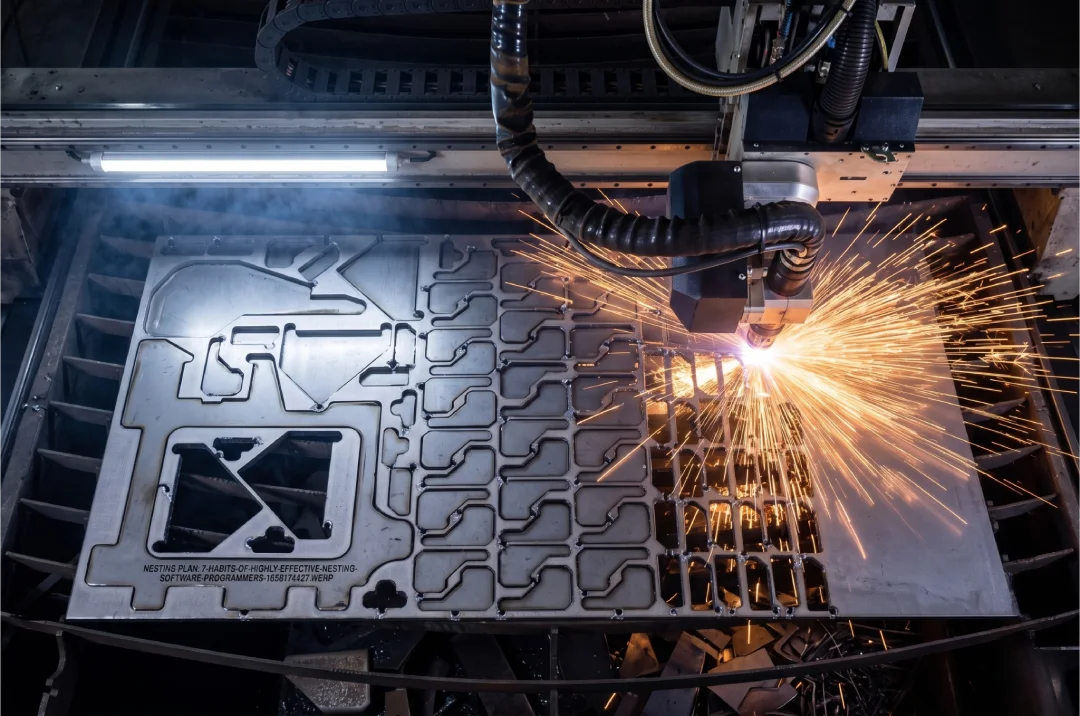
Modern PEB manufacturing uses CAD/CAM-integrated nesting software. Structural designs are converted into part files, and the software automatically arranges them for best sheet utilization.
Typical Workflow:
- Import part drawings from design software
- Group parts by thickness and material grade
- Prioritize urgent or high-volume components
- Generate optimized layouts
- Simulate cutting path
- Send program to fiber laser cutting machine
This automated process improves both speed and consistency.
Modern nesting software performs best when combined with an advanced laser cutting machine. Depending on material thickness and production requirements, manufacturers may utilize a lower power laser cutting machine for thinner materials or a high power laser cutting machine for thick structural steel plates commonly used in PEB fabrication.
To understand the advantages of fiber laser technology in greater detail, manufacturers can explore Advantages of Fiber Laser Cutting in PEB Steel Fabrication.
Types of Nesting Strategies Used
1. Rectangular Nesting
Used for simple parts where components are aligned in rows and columns. Useful for repeated standard shapes.
2. Freeform Nesting
Irregular parts are rotated and placed dynamically to maximize sheet usage.
3. Common-Line Cutting
Two adjacent parts share a common cut line, reducing cut length and saving time.
4. Part-in-Part Nesting
Smaller parts are placed inside openings of larger geometries.
5. Mixed Priority Nesting
Urgent components are inserted into available gaps while maintaining efficiency.
These strategies are highly valuable in PEB manufacturing, where part variety is common.
Role of Fiber Laser Cutting in Material Optimization
Traditional cutting methods often limit nesting flexibility due to kerf width, edge quality, or manual setup constraints. Fiber laser technology overcomes these limitations.
Benefits of Fiber Laser Cutting for Nesting:
- Narrow kerf width for closer part spacing
- High precision for tight layouts
- Ability to cut complex contours
- Fast repositioning between parts
- Consistent edge quality across dense nests
This allows manufacturers to place components closer together while maintaining quality.
Material optimization does not end with cutting. Many manufacturers now integrate laser solutions that combine cutting, welding, and marking operations. Technologies such as a laser welding machine, handheld laser welding machine, and laser engraving machine help improve production flow, reduce manual handling, and increase traceability.
Manufacturers interested in a fully integrated fabrication workflow can explore How Combining Laser Cutting, Welding and Marking Machine Reduces Operational Costs.
For organizations looking to modernize their fabrication operations, SLTL Group offers advanced laser solutions including laser cutting machines, laser welding machines, handheld laser welding machines, and laser engraving machines. To discuss your requirements, contact +91 99250 36495 or email mkt@sltl.com.
Examples in PEB Component Production
- Connection Plates: Base plates, end plates, and gussets are ideal for nested production because multiple shapes can be cut from a single plate.
- Secondary Members: Smaller brackets, cleats, clips, and support tabs can be grouped into leftover areas of larger nests.
- Mixed Project Loads: Multiple customer orders can be combined in one optimized cutting cycle if material thickness matches.
This increases utilization and machine productivity in PEB manufacturing.
Operational Benefits Beyond Material Savings
Material optimization is not only about steel savings. It also improves plant performance.
- Lower Handling Time: Fewer sheets are required to produce the same number of parts.
- Reduced Inventory Pressure: Better planning reduces excess raw material consumption.
- Improved Scheduling: Efficient nests reduce machine bottlenecks and improve job sequencing.
- Better Traceability: Digital nesting systems can track part placement, batch origin, and production sequence.
The same principles are widely used across industries such as Automotive Parts Manufacturing, Tool and Mold Manufacturing, Jewelry Manufacturing, Aerospace, Electronics, Medical Devices, and Construction. These industries depend on advanced laser solutions to improve material utilization, precision, and manufacturing efficiency while reducing waste.
Challenges in Achieving High Nesting Efficiency
Despite the advantages, certain challenges exist:
- Frequent design changes requiring re-nesting
- Mixed thickness materials
- Urgent production priorities disrupting ideal layouts
- Poor data quality from drawings
- Manual planning limitations
These issues can reduce efficiency if not managed through proper software and production discipline.
How Smart Factories Improve Nesting Efficiency
Advanced PEB manufacturing plants integrate nesting with:
- ERP systems for order planning
- CAD/CAM for design transfer
- Production scheduling tools
- Barcode or laser marking for part identification
- Automated sheet loading systems
This creates a seamless digital flow from order to cut part.
Many smart factories also integrate laser engraving machines to improve traceability and part identification. Combined with automated cutting and welding systems, these technologies create a connected manufacturing environment that improves quality control and reduces operational complexity.
Future Trends in Material Optimization
The next phase of nesting efficiency is being driven by intelligent systems. Emerging Trends:
- AI-based nesting decisions
- Real-time cost-based optimization
- Automatic remnant reuse planning
- Multi-machine load balancing
- Predictive material consumption analytics
These innovations will further improve competitiveness in PEB manufacturing.
Best Practices for Manufacturers
To maximize results, manufacturers should:
- Standardize part libraries
- Use advanced nesting software
- Group jobs by thickness and grade
- Reuse remnants strategically
- Review scrap reports regularly
- Integrate nesting with production planning
Consistent discipline often delivers better savings than occasional optimization.
As the industry continues moving toward automation, many manufacturers are investing in laser solutions. These technologies help improve productivity while reducing waste across the entire fabrication process.
Conclusion
Material optimization and nesting efficiency are among the most powerful profit levers in modern PEB manufacturing. Since steel is a major input cost, improving how each plate or sheet is utilized creates direct financial benefits while also enhancing productivity and sustainability. With the support of fiber laser cutting technology and intelligent nesting software, manufacturers can reduce waste, increase throughput, and respond faster to market demand. As the industry moves toward smarter and leaner production models, efficient material planning will remain essential to long-term success.
For manufacturers looking to improve nesting efficiency, material utilization, and overall fabrication productivity, SLTL Group offers advanced laser solutions tailored for modern manufacturing. Whether you require a laser cutting machine, high power laser cutting machine, lower power laser cutting machine, laser welding machine, handheld laser welding machine, or laser engraving machine, our experts can help identify the right solution for your production requirements.
To learn more, contact SLTL Group at +91 99250 36495, email mkt@sltl.com, or visit www.sltl.com.
FAQs: Material Optimization & Nesting Efficiency in PEB Production
1. How can I reduce steel wastage in my PEB fabrication process?
You can reduce steel wastage by using advanced nesting software and a precision laser cutting machine. This helps you place more parts on each sheet and utilize your material more efficiently.
2. Can a fiber laser cutting machine really improve my material utilization?
Yes. A fiber laser cutting machine creates a narrow kerf and high cutting accuracy, allowing you to place parts closer together and reduce scrap generation.
3. Which laser cutting machine is suitable for my PEB manufacturing facility?
The right machine depends on your material thickness, production volume, and application. You may need a lower power laser cutting machine for thinner materials or a high power laser cutting machine for heavy structural steel processing.
4. How much cost can I save by improving nesting efficiency?
Your savings depend on material usage and production volume. Even a small improvement in nesting efficiency can reduce steel consumption and generate significant yearly savings.
5. Can I process columns, rafters, and connection plates on the same laser cutting machine?
Yes. Modern laser cutting machines can process a wide range of PEB components, including columns, rafters, gusset plates, base plates, stiffeners, and brackets.
6. Should I combine laser cutting, welding, and marking in one production workflow?
Yes. When you combine laser cutting, laser welding, and laser marking, you can reduce handling time, improve traceability, and lower overall production costs.
7. Will a handheld laser welding machine help improve my fabrication productivity?
Yes. A handheld laser welding machine can produce faster welds, cleaner joints, and less post-processing compared to many conventional welding methods.
8. How can I track and identify PEB components more efficiently?
You can use a laser engraving machine to mark part numbers, batch details, assembly information, and project references directly on the component for easy traceability.
9. Can SLTL provide a complete laser solution for PEB manufacturing?
Yes. SLTL offers complete laser solutions including laser cutting machines, laser welding machines, handheld laser welding machines, and laser engraving machines for PEB fabrication facilities.
10. How can I choose the right laser solution for my PEB production requirements?
You can discuss your material type, thickness range, production volume, and fabrication challenges with SLTL’s experts. They can recommend the most suitable laser solution for your specific manufacturing needs.
Author Bio

Mayank Patel
R&D HeadMayank Patel is the Head of Research & Development at SLTL Group, bringing over 20+ years of hands-on experience in the field of laser technology. A forward-thinking innovator, he has played a pivotal role in developing advanced laser cutting, welding, and marking solutions tailored for diverse industries. Under his leadership, SLTL’s R&D division continues to push the boundaries of what laser systems can achieve in modern manufacturing.